Characteristic Polynomial for a Difference Equation
Definition
For the homogeneous linear difference equation of order with constant coefficients and ,
the characteristic polynomial is
and is the characteristic equation. Its roots (real or complex, counted with multiplicity) are the characteristic roots.
Interpretation
Substituting the trial solution with gives . So the geometric sequence solves the equation exactly when is a characteristic root, and the problem of solving a recurrence reduces to finding the roots of one polynomial.
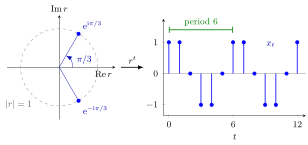
The figure takes the complex-roots example . The roots of lie on the unit circle at the angles (left). Because the solutions neither grow nor shrink, and because each step turns by they return after steps: the solution from (right) is repeated.
The polynomial is read off the equation by replacing with . Its coefficients are those of the equation written with every term on the left; with one must first rewrite to get .
The name is not a coincidence. The equation is equivalent to for the companion matrix of a higher-order equation, and , which is the characteristic polynomial of that matrix up to the factor . Characteristic roots are therefore the eigenvalues of .
Key Results
- is a solution if and only if ; since , is never a root.
- A root of multiplicity gives the solutions ; together over all roots these form a complex basis of solutions for complex-valued sequences.
- Real coefficients make nonreal roots appear in conjugate pairs ; for a real basis, replace each pair of multiplicity by and for .
- Vieta: the roots sum to and multiply to .
- ; if , the equation with constant right-hand side has the equilibrium .
Examples
Distinct roots. has , so .
Repeated root. has . Besides , is a solution: . Hence .
Complex roots. has with roots . So , a solution of period ; from the recursion gives
Fibonacci. has roots and ; with , this gives .
Prerequisites
Related Concepts
- Basis of Solutions of a Difference Equation
- Second-Order Linear Difference Equation
- Higher-Order Linear Difference Equation
- Stability of a Scalar Difference Equation
- Characteristic Equation for a Differential Equation
Sources
- Math V: Advanced Linear Algebra · Week 2
Aliases: characteristic equation of a difference equation, auxiliary equation of a recurrence, characteristic polynomial of a recurrence Keywords: trial solution x_t = r^t, characteristic roots, repeated root t r^t, companion matrix, p(r) = r^k + a_{k-1} r^{k-1} + ... + a_0 Symbols: lambda, phi, pi, psi, rho, square root, theta
Last updated: 27 October 2026 11:52
Characteristic Polynomial for a Difference EquationBasis of Solutions of a Difference EquationHigher-Order Linear Difference EquationStability of a Scalar Difference EquationDifference EquationRoot of a PolynomialCharacteristic PolynomialSecond-Order Linear Difference EquationCharacteristic Equation for a Differential Equation