Differential Equation
Definition
Let be an unknown real-valued function of time , and write for its derivative and for its -th higher-order derivative. An ordinary differential equation (ODE) of order is a relation
in which actually occurs. A solution on an interval is an times differentiable function that satisfies the relation for every .
The equation is linear if it has the form , homogeneous (linear case) if , and autonomous if does not appear explicitly, as in . An initial value problem adds conditions .
Interpretation
A differential equation describes continuous-time change: it states how the rate of change of a quantity depends on time and on the current state. It is the continuous-time counterpart of a difference equation, where the state jumps from to .
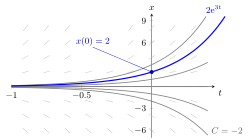
The figure draws the exponential-growth example . Each short grey segment has slope , the rate of change the equation prescribes at state . The grey curves are the solutions for ; each follows the segments everywhere. The initial condition picks out one member of this family, the blue curve .
The unknown is a whole function, not a number. For the linear equations with continuous coefficients considered below, the general solution has free constants, and initial values select exactly one solution. For a general nonlinear equation, the order alone guarantees neither existence nor uniqueness of an initial value problem.
A common misunderstanding is to treat "solution" as a formula valid for all . A solution lives on an interval, and for nonlinear equations it can cease to exist after finite time (see the last example).
Key Results
- The order is the highest derivative that occurs; has order 2, not 3.
- The simplest case with continuous is solved by any antiderivative: .
- For a linear equation with continuous coefficients and on , every initial value problem has exactly one solution, defined on all of .
- For a homogeneous linear equation, sums and scalar multiples of solutions are solutions, so the solutions form a vector space.
- A nonlinear equation can have solutions that exist only on a bounded interval.
Examples
Exponential growth. For , every function is a solution, since . The condition gives , so .
Second order. For , integrating twice gives and : two free constants for an equation of order 2. With , we get .
Finite-time blow-up. For the nonlinear equation with , the function satisfies . It is a solution only on and tends to as .
Prerequisites
Related Concepts
- First-Order Differential Equation
- Second-Order Differential Equation
- System of Differential Equations
- Difference Equation
Sources
- Math V: Advanced Linear Algebra · Week 3
Aliases: ordinary differential equation, ODE Keywords: x'(t), order of a differential equation, initial value problem, autonomous differential equation, linear differential equation Symbols: element of, infinity, integral, real numbers
Last updated: 27 October 2026 11:52
Differential EquationFirst-Order Differential EquationSecond-Order Differential EquationDerivative and DifferentiabilityHigher-Order DerivativeAntiderivativeSystem of Differential EquationsDifference Equation