Complex Conjugate Pair of Eigenvalues
Proposition
Let be a real matrix and let with , , be an eigenvalue of with eigenvector . Then the complex conjugate is also an eigenvalue of , with eigenvector (entrywise conjugate), and and have the same algebraic multiplicity.
Proof. Conjugating and using gives , and . The multiplicity statement holds because the characteristic polynomial has real coefficients, so its factorization is invariant under conjugation.
Interpretation
The characteristic polynomial of a real matrix has real coefficients, so this is the complex conjugate root theorem from Math II applied to eigenvalues. The hypothesis that is real is essential: the complex matrix has eigenvalue but not .
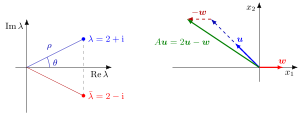
The figure uses the numerical matrix from the examples, . On the left its eigenvalues and are reflections of each other in the real axis, with the same modulus and opposite angles . On the right are the real and imaginary parts and of the eigenvector : the image stays in the plane of and rather than on the line through .
A nonreal eigenvalue has no real eigenvector, so it does not describe a stretched line. Instead the pair acts on a real plane: writing with real , the plane is mapped into itself, and in the coordinates given by the coordinate block is , with in polar form. Thus the coordinate vector rotates by and scales by each step. The basis need not be orthonormal, so this is a similarity description: lengths and angles in the original Euclidean plane need not change by those same rules.
The pair matters for linear difference equations: for it produces oscillating terms and , which decay exactly when .
Key Results
- Nonreal eigenvalues of a real matrix come in pairs, so their number (with multiplicity) is even; a real matrix with odd has at least one real eigenvalue.
- If is an eigenvector for , , then are linearly independent and , , i.e. .
- The pair contributes to and to .
- A real matrix has a nonreal pair if and only if .
- By De Moivre's formula, , so if and only if .
Examples
A numerical matrix. For , and , so and . From the second row of , namely , an eigenvector is ; hence belongs to . Here , , and indeed . Both eigenvalues have modulus .
Rotation. has characteristic polynomial and eigenvalues , with eigenvectors and . For not a multiple of they are nonreal and have modulus .
Odd dimension. A real matrix cannot have eigenvalues : the conjugate would be a fourth eigenvalue.
Prerequisites
- Eigenvalue and Eigenvector
- Characteristic Polynomial
- Complex Conjugate
- Complex Conjugate Root Theorem
Related Concepts
- Second-Order Linear Difference Equation
- Stability of a System of Linear Difference Equations
- Matrix Representation of a Linear Map
- De Moivre's Formula
Sources
- Math V: Advanced Linear Algebra · Week 1
Aliases: conjugate pair of eigenvalues, complex conjugate eigenvalues, complex eigenvalues of a real matrix, conjugate eigenvalues Keywords: a + bi and a - bi, conjugate eigenvector, real canonical form, rotation-scaling block Symbols: complex numbers, element of, lambda, pi, real numbers, rho, square root, theta
Last updated: 27 October 2026 11:52
Complex Conjugate Pair of EigenvaluesEigenvalue and EigenvectorCharacteristic PolynomialComplex ConjugateComplex Conjugate Root TheoremSecond-Order Linear Difference EquationStability of a System of Linear Difference EquationsMatrix Representation of a Linear MapDe Moivre's Formula