Stability of an Equilibrium
Proposition
Let be an equilibrium of , where .
- is stable if solutions that start close to stay bounded near it: for every there is such that implies for all .
- is (locally) asymptotically stable if it is stable and, in addition, as for every close enough to .
- is unstable if it is not stable.
Linearization test. If is continuously differentiable near , then
- implies that is locally asymptotically stable;
- implies that is unstable;
- gives no conclusion.
In Math V, stable means that solutions stay bounded (near the equilibrium); if, in addition, every nearby solution converges to the equilibrium, it is asymptotically stable.
Beyond the course
Many textbooks call the - notion above Lyapunov stability. Math V does not use that name; it simply says stable.
Interpretation
Near , the Taylor polynomial of degree 1 gives , so the deviation approximately obeys , with solution . A negative derivative makes small deviations decay; a positive one makes them grow. Graphically: is asymptotically stable when crosses zero from positive to negative.
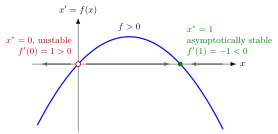
The figure shows the logistic example below, . The sign of gives the direction of motion on the -axis: to the right where , to the left where . At the graph crosses zero upwards, , and nearby solutions move away; at it crosses downwards, , and nearby solutions move towards it from both sides.
The continuous-time criterion is a sign condition, . The discrete-time criterion is a size condition: for the linear equation (see stability of a scalar difference equation), and, by the same linearization, for a fixed point of with continuously differentiable. Mixing the two is a common error.
Stability in the test is local: it says nothing about initial values far from . Asymptotic stability also requires the limit at infinity ; bounded motion near is not enough.
Key Results
- For with , : the equilibrium is globally asymptotically stable if and unstable if .
- For every point is an equilibrium that is stable but not asymptotically stable.
- When , all three outcomes occur: (asymptotically stable), (unstable) and (unstable, although solutions starting below approach it).
- For linear systems, the analogue is that all eigenvalues must have negative real part; see linear vector ODE and stability of higher-order ODEs.
Examples
Logistic equation. , so and . At , : unstable. At , : locally asymptotically stable. Near , deviations shrink roughly like .
Linear with forcing. has and , so is asymptotically stable. From : and .
Inconclusive test. For , . Yet for , so decreases, and indeed : the equilibrium is asymptotically stable although the test is silent.
Prerequisites
Related Concepts
- Stability of Solutions of Higher-Order ODEs
- Linear Vector ODE
- Stability of a Scalar Difference Equation
- Stability of a System of Linear Difference Equations
Sources
- Math V: Advanced Linear Algebra · Week 3
Aliases: stable equilibrium, asymptotic stability, asymptotically stable equilibrium Keywords: f'(x*)<0, unstable equilibrium, linearization test, local stability, Lyapunov stability Symbols: delta, epsilon, infinity
Last updated: 14 October 2026 08:21
Stability of an EquilibriumLinear Vector ODEStability of Solutions of Higher-Order ODEsEquilibrium of a Differential EquationDerivative and DifferentiabilityLimit at InfinityStability of a Scalar Difference EquationStability of a System of Linear Difference Equations