Row Space
Definition
Let be a real matrix with rows , so that each . The row space of is the span of its rows,
It is the column space (range) of the transpose : . Math V writes , and for the column space, row space and null space.
Interpretation
Each row of is the coefficient vector of one equation of . The row space therefore contains the coefficient vectors of all equations that follow from the system by taking linear combinations of its equations.
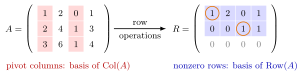
The figure uses the example below. Row operations replace rows by combinations of rows, so and have the same row space, and the two nonzero rows of (blue) are a basis of ; row 3 of , which is row 1 plus row 2, becomes a zero row. The pivots of (circled) sit in columns 1 and 3, and it is these columns of the original (red), not of , that form a basis of the column space.
The row space lives in the domain , alongside the null space; the column space lives in the codomain . Only the component of in the row space affects .
Row operations and column bases behave differently. Elementary row operations replace rows by combinations of rows, so they keep the row space but usually change the column space. Hence a basis of the row space is read off from the nonzero rows of the echelon form, while a basis of the column space consists of the pivot columns of the original matrix.
Key Results
- Row-equivalent matrices have the same row space.
- The nonzero rows of any row echelon form of , in particular of its reduced row echelon form, form a basis of the row space.
- : row rank equals column rank.
- , the orthogonal complement of the null space (kernel), so (Fundamental Theorem of Linear Algebra).
- restricted to is a bijection onto the column space .
Examples
Let
by , , then . A basis of the row space is , so (row 3 of is row 1 plus row 2).
Orthogonality check. Solving gives the null-space basis . Each is orthogonal to both row-space basis vectors, for instance , and .
Membership. lies in the row space. does not, since its dot product with is .
Column space is different. The pivot columns are columns 1 and 3, so , whereas the columns of all have third entry .
Prerequisites
Related Concepts
Sources
- Math V: Advanced Linear Algebra · Week 5
Aliases: row space of a matrix, column space of the transpose, range of the transpose Keywords: Row(A), Col(A^T), range of A^T, row rank, basis from echelon form Symbols: element of, real numbers, subset
Last updated: 22 October 2026 19:04
Row SpaceFundamental Theorem of Linear AlgebraLinear SpanTransposeElementary Row OperationRow Echelon and Reduced Row Echelon FormRankOrthogonal ComplementKernelRange of a Linear Map