Equilibrium of a Differential Equation
Definition
Consider the autonomous first-order differential equation
where and is a given real function. A number is an equilibrium (steady state) if . Equivalently, the constant function is a solution.
For a vector equation with , an equilibrium is a vector with .
Interpretation
At an equilibrium the rate of change is zero, so the constant trajectory is a solution. It is the only solution starting there when local uniqueness holds, for example when is continuously differentiable near the equilibrium. Finding equilibria is an algebraic task: they are the zeros of ; no differential equation needs to be solved.
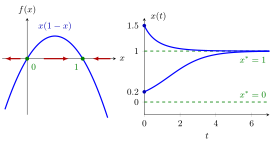
The figure shows the logistic example . On the left, the equilibria are the zeros and of , and the arrows on the axis form the phase line: to the right where , to the left where . On the right, the equilibria appear as constant solutions (dashed). The solution from rises towards , and a solution from falls towards ; neither crosses an equilibrium line.
The sign of between consecutive equilibria shows the direction of motion: where solutions increase, where they decrease. This one-dimensional picture is called the phase line. Whether nearby solutions approach the equilibrium is a separate question, treated in stability of an equilibrium.
Two misunderstandings occur often. An equilibrium is a value of the state , not a time . And an equilibrium need not be reached: in the solution approaches but never equals it when . For a non-autonomous equation , a constant is a solution only if for every .
Key Results
- Equilibria of are exactly the constant solutions.
- For with there is a unique equilibrium , and every solution satisfies .
- For with : every point is an equilibrium if ; there is none if .
- If is continuously differentiable, solutions cannot cross or touch an equilibrium (uniqueness of solutions), so a solution starting between two equilibria stays between them and is monotone.
- For with invertible, the unique equilibrium is , using the inverse matrix.
Examples
Linear. : gives . The solution with is .
Logistic equation. has equilibria and . Since on , a solution with increases and stays in ; it tends to . For , and solutions decrease towards .
No equilibrium. has for every , so there is no equilibrium and every solution is strictly increasing.
Vector case. For and , solve : the second row gives , so ; the first row gives , so . Thus .
Prerequisites
Related Concepts
- Stability of an Equilibrium
- Linear Vector ODE
- Particular Solution of an Inhomogeneous Linear ODE
- Stability of a Scalar Difference Equation
Sources
- Math V: Advanced Linear Algebra · Week 3
Aliases: equilibrium point, steady state, rest point, equilibrium solution, equilibrium state Keywords: constant solution, f(x)=0, x=-b/a, autonomous equation, phase line, logistic equation Symbols: element of, real numbers
Last updated: 27 October 2026 11:52
Equilibrium of a Differential EquationStability of an EquilibriumFirst-Order Differential EquationZero of a FunctionConstant FunctionLinear Vector ODEParticular Solution of an Inhomogeneous Linear ODEStability of a Scalar Difference Equation