(orthogonality) Null(A)=Row(A)⊥ and Null(A⊤)=Col(A)⊥.
Consequently Rn=Row(A)⊕Null(A) and Rm=Col(A)⊕Null(A⊤), both direct sums of mutually orthogonal subspaces. Math II writes kerA and rangeA for Null(A) and Col(A). The course gives the fourth subspace, Null(A⊤), no separate name; some textbooks call it the left null space.
Part 1 combines the Fundamental Theorem of Linear Maps (rank–nullity, dimNull(A)+dimCol(A)=n) with the fact that row rank equals column rank, applied to both A and its transpose.
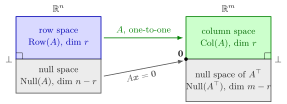
In the figure the domainRn is split into the row space (dimensionr) and the null space (dimension n−r), and the codomainRm into the column space (dimension r) and the null space of A⊤ (dimension m−r); the right-angle marks stand for the orthogonality in Part 2. The matrix A carries the row space one-to-one onto the column space and sends the whole null space to 0. In the example below, r=1,n=2,m=3, so the four dimensions are 1,1,1,2.
Part 2 is almost a one-line proof. Ax=0 says that every row of A has dot product 0 with x, so x is orthogonal to all rows and hence to their span; this is exactly membership of the orthogonal complement of the row space. Applying the same argument to A⊤ gives the second identity.
The pairs live in different spaces: row space and null space in the domain Rn, column space and Null(A⊤) in the codomain Rm. Row space and column space have the same dimension r. For a non-square matrix they lie in different spaces, and even for a square matrix they are in general neither equal nor orthogonal.
Full column rank (r=n) holds if and only if Null(A)={0}; full row rank (r=m) holds if and only if Null(A⊤)={0}, if and only if Ax=b is solvable for every b.
Null(A⊤A)=Null(A), so rank(A⊤A)=rankA; this is what makes the normal equations of least squares work.
Aliases: four fundamental subspaces theorem, theorem of the four subspaces
Keywords: four fundamental subspaces, left null space, Col(A), Row(A), Null(A), Null(A) = Row(A)^⊥, Null(A^T) = Col(A)^⊥, r, n-r, r, m-r
Symbols: element of, real numbers, subset
Last updated: 16 October 2026 22:28
Fundamental Theorem of Linear AlgebraLeast SquaresSingular Value DecompositionKernelRange of a Linear MapFundamental Theorem of Linear MapsRow SpaceOrthogonal ComplementOrthogonal ProjectionMoore-Penrose Inverse