Let V and W be finite-dimensional vector spaces over the same field, with an ordered basisB=(v1,…,vn) of V and an ordered basis C=(w1,…,wm) of W. For a linear mapA:V→W, write each image of a basis vector in the basis C:
Avj=i=1∑maijwi,j=1,…,n.
The matrix representation of A with respect to B and C is the m×nmatrix[A]C,B=(aij). Its j-th column is the coordinate vector [Avj]C. When V=W and B=C, one writes [A]B.
A linear map is fixed by its values on a basis, so the n columns [Avj]C carry all the information about A. The matrix turns the abstract map into arithmetic on coordinates: [Av]C=[A]C,B[v]B for every v∈V.
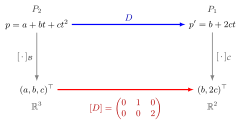
The figure uses the differentiation example below, with B=(1,t,t2) and C=(1,t). Going right along the top applies the map D itself; going down takes coordinates. Both paths from p to (b,2c)⊤ agree: differentiating and then taking coordinates gives the same vector as taking coordinates and then multiplying by [D].
The matrix depends on the map and on both chosen bases, including their order. A frequent mistake is to put the coordinates of Avj in rows instead of columns, or to write them in the standard basis when C is a different basis. For a map Rn→Rm with the standard bases the representation is the standard matrix from Math II.
The idea matters for eigenvalue problems, which are basis-free questions about a map: choosing a basis of eigenvectors makes the representing matrix diagonal, which is the content of diagonalization.
For the identity map on V and two ordered bases B,C of V,[I]C,B equals the identity matrixIn if and only if C=B; otherwise it converts B-coordinates into C-coordinates (see change of basis).
If P is the invertible matrix whose columns are the B-coordinates of a second basis B′ of V, then [A]B′=P−1[A]BP. Representations of one operator are therefore similar and share determinant, trace and eigenvalues.
An operator on V is invertible if and only if one (equivalently every) representing matrix is invertible.
A map R2→R3. For A(x,y)=(x,y,x+y) with standard bases, Ae1=(1,0,1)⊤ and Ae2=(0,1,1)⊤, so
[A]=101011.
Differentiation. Let D:P2→P1,p↦p′, with bases (1,t,t2) and (1,t). Then D1=0,Dt=1,Dt2=2t, so [D]=(001002). Check: p=a+bt+ct2 has coordinates (a,b,c)⊤ and [D](a,b,c)⊤=(b,2c)⊤, i.e. p′=b+2ct.
Same operator, two bases. The operator with standard matrix A=(2112) satisfies A(1,1)⊤=(3,3)⊤ and A(1,−1)⊤=(1,−1)⊤. In the basis B′=((1,1)⊤,(1,−1)⊤) its representation is (3001): same map, same eigenvalues 3 and 1, simpler matrix.
Aliases: matrix of a linear map, matrix of a linear transformation, representing matrix
Keywords: [A]_{C,B}, standard matrix, coordinate vector, columns are images of basis vectors
Symbols: element of, real numbers, sum
Last updated: 14 October 2026 08:21
Matrix Representation of a Linear MapChange of BasisLinear MapBasisCoordinateMatrix ProductSimilarity TransformationComplex Conjugate Pair of EigenvaluesDiagonalization