Common Prior
Definition
In a game with types , a common prior is a single probability distribution on that is common knowledge among the players and from which every player's beliefs are derived. Player of type (with ) holds the conditional belief
where denotes the types of the other players. For finite type spaces, is a joint probability mass function of the type profile.
Interpretation
The common prior assumption says that players differ in what they know, not in how they interpret the world: any difference in beliefs comes from different private information. Each type's belief is the conditional probability of the others' types given her own, obtained from by Bayes' rule.
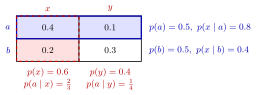
The figure shows the correlated example below as one table that both players read. Player 1 of type knows she is in the outlined row and rescales it by its total , giving ; player 2 of type knows she is in the dashed column and rescales it by , giving . Different types end up with different beliefs only because they condition on different parts of the same .
This is what lets a Bayesian game be written as one game with Nature moving first, the Harsanyi transformation: Nature draws from , and everyone knows that it does.
When types are correlated, a player's own type is informative about the others', so different types of the same player hold different beliefs; using the marginal distribution of in that case is a frequent error. Only independent types give every type the same belief (Key Results).
Key Results
- Beliefs consistent with a common prior satisfy for all and .
- With independent types, and for every type : all types of player hold the same belief, the product of the others' marginals.
- Not every belief system comes from a common prior: two players without private information who assign different probabilities to the same event cannot share one. More generally (Aumann's agreement theorem), under a common prior, posteriors about an event that are common knowledge must be equal.
- Under a common prior, a type's expected payoff is computed with ; the ex ante expected payoff averages these with weights .
Examples
Correlated types. Let , and
The entries sum to 1. Type has and believes ; type believes . Player 2 has , , so type believes and type believes .
Independent types. If each with probability independently, for each of the four profiles and every type believes the other is low-cost with probability .
Prerequisites
Related Concepts
Sources
- Game Theory · Week 5
Aliases: common prior assumption, CPA, Harsanyi doctrine Keywords: prior distribution over types, p(theta), p(theta_{-i} | theta_i), posterior beliefs, consistent beliefs, agreeing to disagree Symbols: element of, product, sum, theta
Last updated: 17 October 2026 21:53
Common PriorBayes Rule for BeliefsBayesian GamePooling EquilibriumPrivate-Value AuctionTypeCommon KnowledgeConditional ProbabilityBayes RuleHarsanyi TransformationJoint Probability Mass Function