Sequential Rationality
Definition
In an extensive-form game, let the other players follow . Player 's strategy is sequentially rational if, at every information set at which moves, the continuation of from onwards is a best response to , that is, it maximizes 's expected payoff from onwards. This must hold whether or not is reached when is played.
If is a single node, the expected payoff from is well defined. If contains several nodes, it is computed with a belief , a probability distribution over the nodes of , so sequential rationality is defined relative to these beliefs.
Interpretation
Sequential rationality says a player optimizes whenever she is called upon to move, not only when planning at the start of the game. It formalizes credibility: a threat or promise is credible only if carrying it out would be optimal at the moment it has to be carried out.
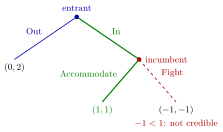
The figure draws the entry game of the Examples, with payoffs listed as (entrant, incumbent). In the Nash equilibrium (Out, Fight) the incumbent's node is never reached, so the threat to fight costs her nothing. Sequential rationality asks what she would do if the node were reached: Accommodate gives , so Fight is not a credible plan, and only the highlighted path (In, Accommodate) survives.
Nash equilibrium does not impose this. In a Nash equilibrium a player must optimize at information sets that are reached with positive probability, but at unreached information sets any action is consistent with ex-ante optimality, because it does not change her payoff. This is the gap through which non-credible threats enter.
Backward induction builds a profile that is sequentially rational at every node of a perfect-information game, and subgame-perfect Nash equilibrium imposes the same requirement subgame by subgame. Where information sets contain several nodes, beliefs are needed; this leads to perfect Bayesian equilibrium.
Key Results
- In a Nash equilibrium, each player's strategy is optimal at every information set reached with positive probability; off the path her own best-response condition does not restrict it (only the other players' incentives may).
- In a finite game of perfect information, a pure-strategy profile in which every player is sequentially rational at every node is a backward-induction profile, hence an SPNE, and conversely.
- At a non-singleton information set, the optimal action can change with the belief .
- In multistage and repeated games, the one-stage deviation principle reduces the check to single-period deviations.
Examples
Entry game. Out gives to (entrant, incumbent); after In, Accommodate gives and Fight . The profile (Out, Fight) is a Nash equilibrium, but Fight is not sequentially rational: at the incumbent's node, Accommodate gives . Only (In, Accommodate) is sequentially rational for both players.
Optimality depending on beliefs. An incumbent observes entry but not whether the entrant is ready () or unready (); both nodes are in one information set. Her payoffs are: against , Fight and Accommodate ; against , Fight and Accommodate . With belief that the entrant is ready,
Fight is sequentially rational if and only if , that is ; Accommodate is sequentially rational if and only if . At both are.
Prerequisites
Related Concepts
- Subgame-Perfect Nash Equilibrium
- Backward Induction
- System of Beliefs
- Perfect Bayesian Equilibrium
- One-Stage Deviation Principle
- Equilibrium Path
Sources
- Game Theory · Week 3
Aliases: sequentially rational, sequentially rational strategy Keywords: credibility, optimal at every information set, off-path optimality, non-credible threat, beliefs at an information set, entry game Symbols: mu, sigma
Last updated: 27 October 2026 11:52
Sequential RationalityPerfect Bayesian EquilibriumBest ResponseExtensive-Form GameInformation SetSubgame-Perfect Nash EquilibriumBackward InductionSystem of BeliefsOne-Stage Deviation PrincipleEquilibrium Path