Stackelberg Competition
Definition
Stackelberg competition is a quantity-setting duopoly with sequential moves. Firm 1 (the leader) chooses ; firm 2 (the follower) observes and then chooses . With linear inverse demand , constant marginal cost and , , the profits are, for ,
The leader's strategy is a quantity ; the follower's strategy is a function giving her quantity after every possible .
Interpretation
The game is the sequential version of the Cournot duopoly and is solved by backward induction. The follower's best response after observing follows from the first-order condition :
The leader substitutes this into her own profit. For this gives , a concave function maximized where .
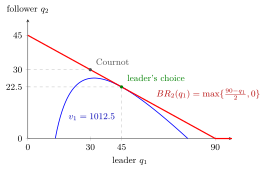
The figure uses the numbers of the Examples (, , ). Because the follower plays , the leader in effect chooses a point on that response graph, whose zero-output branch begins at . Her profit is highest where one of her iso-profit curves just touches it: the curve touches at . The Cournot point also lies on but gives the leader only ; the difference is the value of commitment.
The leader gains because her quantity is a commitment: it is observed and cannot be revised, so she can push the follower to produce less. If the follower could not observe , the game would be strategically simultaneous and the Cournot outcome would result. A frequent error is to report the follower's equilibrium strategy as the number ; the strategy is the whole function , and the number is only its value on the equilibrium path.
Key Results
- Subgame-perfect Nash equilibrium (SPNE): and , so on the path .
- Total output and price .
- Profits and .
- Compared with Cournot (, ): the leader produces and earns more, the follower produces and earns less, total output is higher and the price lower.
- There are Nash equilibria that are not subgame perfect, sustained by a follower strategy that does not best respond off the path.
Examples
Numbers. Let , , . The follower plays . The leader maximizes , so . Then , , , and . In the Cournot game each firm produces at price and earns .
A Nash equilibrium that is not subgame perfect. Let the follower use the constant strategy for every , and the leader play . The leader's best response to a fixed is , and on the path the follower's is optimal, so this is a Nash equilibrium with the Cournot outcome. It is not subgame perfect: after, say, the follower should produce , not . The threat to ignore the leader's quantity is not credible.
Prerequisites
Related Concepts
- Subgame-Perfect Nash Equilibrium
- Strategy in an Extensive-Form Game
- Bertrand Duopoly
- Sequential Rationality
Sources
- Game Theory · Week 3
Aliases: Stackelberg duopoly, Stackelberg model, leader–follower model, leader-follower model, Stackelberg game, Stackelberg leadership model Keywords: Stackelberg leader, Stackelberg follower, first-mover advantage, sequential quantity competition, q1 = (a−c)/(2b), q2 = (a−c)/(4b) Symbols: infinity
Last updated: 27 October 2026 11:52
Stackelberg CompetitionCournot DuopolyBackward InductionBest ResponseFirst-Order ConditionSubgame-Perfect Nash EquilibriumStrategy in an Extensive-Form GameBertrand DuopolySequential Rationality