Separating Equilibrium
Definition
In a signalling game, a separating equilibrium is a perfect Bayesian equilibrium in which different types of the sender choose different messages: whenever . In the finite-type model considered here, on-path messages sent with positive probability reveal the type, so the receiver's beliefs are degenerate:
so after every positive-probability message the receiver knows the sender's type and best responds to it. A message prescribed only for a zero-prior type is off the path; its belief is not determined by this Bayes ratio.
Interpretation
On the equilibrium path, separation makes the message reveal the private information. The beliefs follow from Bayes' rule: if only a positive-prior type sends , the posterior puts probability one on .
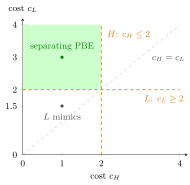
The figure plots the two incentive constraints of the example below. With acceptance after and rejection after , type is willing to pay for only if , and type refrains from mimicking only if , so the separating profile in which sends is a PBE exactly in the shaded region. The pair lies inside it, while lies below the line , where would mimic. The region lies on or above the diagonal . Strictly lower cost is not necessary: at , both incentive constraints bind and both types are willing to follow the separating profile.
The binding conditions are the senders' incentive constraints: each type must weakly prefer its own message and the receiver's response to any alternative message and its response. Equal payoffs permit either choice. In general these comparisons depend on type-specific benefits and costs; separation does not require a universal strict ordering of signal costs. In the example below, type must find cheap enough to be worth being accepted, and type must find it expensive enough not to copy .
Two misconceptions are common. First, a costly signal uses resources: in the example below produces nothing, and type pays to be identified. This cost alone does not establish Pareto inefficiency within the same game. An efficiency comparison must specify which alternative information or allocation is feasible. Second, when the message space contains messages that no type sends, off-path beliefs still matter, because they determine whether a type would deviate to an unused message.
Key Results
- In a separating PBE every on-path belief is or ; the receiver plays a complete-information best response to each type.
- Incentive compatibility: for every type and every message , including unused ones.
- With two positive-prior types and two messages, a separating PBE leaves no message off the path, so Bayes' rule pins down both beliefs.
- Separating and pooling equilibria can coexist in the same game.
Examples
Two types, two messages. In the signalling game example, now with general costs, type (prior ) and type send for free or at cost or . The receiver accepts if and rejects if it is below ; the sender gets if accepted and if rejected, minus her cost. In the candidate separating profile, sends and sends , so the receiver accepts after and rejects after . The incentive constraints are
With and both hold: gets (versus ) and gets (versus ), so this is a separating PBE.
When separation fails. Keep but let . Then would mimic: . No separating PBE with sending exists. The reverse assignment ( sends , sends ) also fails: the receiver would accept after and reject after , so would get rather than .
Prerequisites
Related Concepts
Sources
- Game Theory · Week 7
Aliases: separating PBE, fully revealing equilibrium Keywords: different types send different messages, incentive compatibility, mimicking, single-crossing Symbols: mu, theta
Last updated: 27 October 2026 11:52
Separating EquilibriumSignalling GamePerfect Bayesian EquilibriumBayes Rule for BeliefsPooling EquilibriumSystem of BeliefsAdverse SelectionForward Induction