Private-Value Auction
Definition
In a private-value auction, one indivisible object is sold to one of bidders. Bidder has a valuation for the object that is known only to and that does not depend on the information of the other bidders. In a sealed-bid format the bidders simultaneously submit bids (open formats such as the English and Dutch auctions work analogously with planned drop-out or stopping prices); the auction rules map the bid profile to a winner and to payments . Bidder 's payoff is
(in first- and second-price auctions a loser pays ). In the independent private-values (IPV) model the valuations are i.i.d. draws from a cumulative distribution function on an interval , and is common knowledge.
Interpretation
An auction with private values is a Bayesian game: bidder 's type is , the distribution plays the role of the common prior, and a strategy is a bidding function giving a bid for every possible valuation. The solution concept is Bayesian Nash equilibrium: every type's bid maximizes its expected payoff given the rivals' bidding functions.
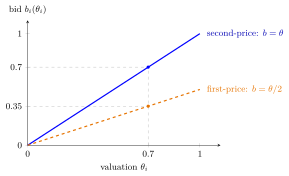
The figure draws the two equilibrium bidding functions of the Examples (, values ). A strategy is the whole line, one bid for every type, not a single number: in the second-price auction each type bids its value, in the first-price auction each type shades its bid to half its value. The type therefore bids or , yet both bids give the same interim expected payoff .
"Private" refers to two things: each bidder knows its own value, and learning the rivals' information would not change that value. This is what distinguishes it from a common-value auction, where the rivals' signals are informative about one's own value. A frequent confusion is to think that private values must differ across bidders; they may coincide, the point is only that each value is a matter of personal taste rather than an estimate of a shared quantity.
The format matters for strategy but, under the conditions of the revenue equivalence theorem, not for expected revenue.
Key Results
- In a second-price auction, bidding is weakly dominant for every type.
- In a first-price auction with IPV values from , the symmetric BNE is : bids are shaded below value.
- With IPV values from , both formats give expected revenue , the expected second-highest valuation.
- In the standard formats the object goes to the bidder with the highest valuation in the symmetric equilibrium, so the allocation is efficient.
Examples
Two bidders, uniform values. Let and independent. In a second-price auction, bidder 1 bids . If , she wins with probability and pays when , so her expected payoff is .
In a first-price auction the symmetric BNE is . With she bids , wins with probability and gets , the same interim expected payoff.
Prerequisites
Related Concepts
Sources
- Game Theory · Week 6
Aliases: Private Value Auction, private-values auction Keywords: independent private values, IPV, valuation theta_i, bidding function b_i(theta_i), sealed-bid auction Symbols: integral, theta
Last updated: 14 October 2026 08:21
Private-Value AuctionCommon-Value AuctionEnglish AuctionFirst-Price AuctionSecond-Price AuctionBayesian GameTypeCommon PriorBayesian Nash EquilibriumRevenue Equivalence Theorem