Extensive-Form Game
Definition
An extensive-form game (with complete information) specifies:
- a finite set of players ;
- a game tree, the rooted and directed version of a tree: a set of nodes with a unique root , edges pointing away from the root, and every other node having exactly one immediate predecessor; nodes without successors are terminal nodes, the others are decision nodes;
- for every decision node, the player who moves there (possibly Nature, which chooses according to a fixed probability distribution);
- for every decision node, the set of actions available there, each action leading to one immediate successor;
- for each player, a partition of her decision nodes into information sets, with the same actions available at all nodes in an information set;
- a payoff for every player at every terminal node .
The whole structure is common knowledge. The game has perfect information if every information set is a single node, and imperfect information otherwise.
Interpretation
The normal-form game lists strategies and payoffs; the extensive form adds the order of moves and what each player knows when she moves. Because each terminal node is reached by a unique path from the root, a terminal node is the same thing as a complete play of the game.
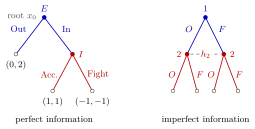
On the left is the entry game of the Examples (Acc. = Accommodate): the entrant moves at the root , the incumbent moves only after In, and each terminal node carries the payoff vector . Every information set is a single node, so the game has perfect information. On the right, player 2 does not observe whether player 1 chose or : the dashed line puts her two nodes into one information set with the same actions at both, and the tree represents the simultaneous Battle of the Sexes.
"Simultaneous" does not need to mean "at the same time": a move counts as simultaneous with an earlier one when it is made without observing it. This is drawn by placing the later mover's nodes in one information set (a dashed line or oval). Hence a static game can be written in extensive form, and the order in which the simultaneous movers are drawn is irrelevant.
The extra structure is what allows one to ask whether threats are credible. The normal form of an extensive-form game keeps the same Nash equilibria but loses the timing, so it cannot distinguish credible from non-credible behaviour.
Key Results
- Every extensive-form game has a normal-form representation whose pure strategies are the strategies of the extensive form; different extensive forms can have the same normal form.
- If player has information sets with actions, she has pure strategies.
- Nash equilibria of an extensive-form game are defined as those of its normal form.
- Every finite game of perfect information has a pure-strategy Nash equilibrium, obtained by backward induction (Zermelo, Kuhn).
- Each decision node with a singleton information set whose successors do not cut an information set starts a subgame.
Examples
Entry game. An entrant chooses Out, giving payoffs to , or In. After In, the incumbent chooses Accommodate, , or Fight, . The incumbent has one information set with two actions, so the normal form is 2×2:
| Accommodate | Fight | |
|---|---|---|
| Out | ||
| In |
Its pure Nash equilibria are (In, Accommodate) and (Out, Fight). In the second, the threat to fight is never tested because entry does not occur.
Sequential Battle of the Sexes. Player 1 chooses or ; player 2 observes the choice and then chooses or . Player 2 has two singleton information sets with two actions each, hence strategies, while player 1 has . If player 2 does not observe player 1's move, her two nodes form one information set and she has only strategies: the game becomes the simultaneous Battle of the Sexes.
Prerequisites
Related Concepts
- Information Set
- Strategy in an Extensive-Form Game
- Subgame
- Backward Induction
- Multistage Game
- Battle of the Sexes
Sources
- Game Theory · Week 3
Aliases: extensive form, game tree, dynamic game, extensive-form representation, game in extensive form, sequential-move game, sequential game Keywords: decision node, terminal node, root, perfect information, imperfect information, entry game, move of Nature, Battle of the Sexes
Last updated: 17 October 2026 21:53
Extensive-Form GameBackward InductionEquilibrium PathForward InductionHarsanyi TransformationInformation SetMultistage GameSequential RationalitySignalling GameStrategy in an Extensive-Form GameSubgameSystem of BeliefsNormal-Form GameNash EquilibriumCommon KnowledgeTreeBattle of the Sexes