Indifference Principle for Mixed Strategies
Proposition
Let be a profile of mixed strategies in a finite normal-form game, and let be the support of . Then is a Nash equilibrium in mixed strategies if and only if, for every player , there is a number such that
In that case is player 's equilibrium payoff.
Interpretation
The reason is that is a weighted average. If one strategy in the support earned less than another, an expected payoff maximizer could move its probability to the better one and gain. So all strategies used must tie, and none unused may do better.
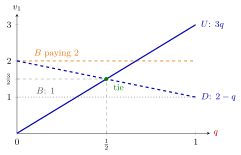
The figure draws player 1's side of the example. Against , earns and earns . Player 1 is willing to mix only where the two lines cross, at with value ; this is how player 1's indifference pins down player 2's probability. The flat lines are the extra row of the second example: paying stays below , so the equilibrium survives, while a paying lies above it and violates the second condition.
In a two-player game, these conditions constrain one player's mixing probabilities through the other player's indifference equations. The usual error is to solve a player's own indifference for her own probabilities. An equation may be an identity rather than determine a unique probability: if every payoff is zero, all mixtures make both players indifferent and every profile is an equilibrium. With more than two players, a player's indifference equations can involve several opponents' mixtures together.
Indifference is not the whole test. The second line (no profitable strategy outside the support) must also be checked, and a strategy outside the support may earn exactly . Indifference also means the player has no strict reason to use the equilibrium weights; the Harsanyi purification theorem gives one justification for them.
Key Results
- The two conditions are necessary and sufficient for to be a Nash equilibrium.
- The equilibrium payoff can be computed from any single pure strategy in the support.
- A strictly dominated strategy never lies in the support of an equilibrium strategy.
- In a game with no pure-strategy equilibrium, there is a unique equilibrium; it is fully mixed, and each player's probability solves the other player's indifference equation.
- Finding equilibria by support enumeration: guess the supports, solve the indifference equations, then check that probabilities lie in and that no strategy outside the support does better.
Examples
A game. Payoffs (player 1, player 2):
There is no pure equilibrium: from player 2 switches to ; from player 1 switches to ; from player 2 switches to ; from player 1 switches to . Let and .
- Player 1 indifferent: , so .
- Player 2 indifferent: , so .
Equilibrium payoffs: and .
Checking outside the support. Add a third row that gives player 1 the payoff against both columns. Against it earns , so the profile above (with ) is still an equilibrium. If instead gave player 1 the payoff against both columns, it would earn and the profile would fail the second condition.
Rock-Paper-Scissors. With payoffs (win), (loss), (tie), each pure strategy earns against the uniform mixture, so uniform play by both players is an equilibrium with value .
Prerequisites
Related Concepts
Sources
- Game Theory · Week 2
Aliases: indifference principle, indifference condition, equal-payoff condition Keywords: support, make the opponent indifferent, solving for mixed equilibrium, 2×2 game, Rock-Paper-Scissors Symbols: element of, sigma, sum
Last updated: 27 October 2026 11:52
Indifference Principle for Mixed StrategiesChicken GameMatching PenniesMixed StrategyNash Equilibrium in Mixed StrategiesExpected Payoff MaximizationNash Existence TheoremHarsanyi Purification TheoremStrictly Dominated Strategy