Bayes Rule for Beliefs
Method
Let be an assessment: a strategy profile and a system of beliefs . For an information set and a node , write for the probability that play reaches when Nature moves according to the common prior and players follow . If , beliefs are consistent with Bayes' rule at when, for every ,
Two types. Suppose an entrant is competitive () with prior probability and weak () with probability , and type enters with probability and type with probability . If , the incumbent's belief after observing entry is
If , entry is off the equilibrium path and the formula places no restriction on .
Interpretation
This is Bayes' rule applied to the nodes of an information set: the prior over types is updated with the probability that each type takes the observed action. The denominator is the total probability of the observed action, by the law of total probability.
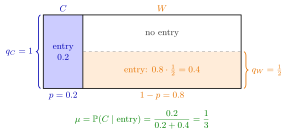
The figure draws the mixed-strategy example below. The widths of the two strips are the prior probabilities and , and the shaded height in each strip is that type's entry probability, and . Observing entry means play is somewhere in the shaded area, of total size ; the posterior is the share of that area belonging to type , namely .
The new element compared with Year-1 probability is that the "likelihoods" are not given by nature but chosen in equilibrium: they come from the players' strategies, possibly a mixed strategy. Beliefs and strategies are therefore determined jointly, and a change in one type's behaviour changes what the other side infers.
A common mistake is to apply the formula at an information set that is reached with probability zero, or to conclude that off-path beliefs must equal the prior. Neither is implied: Bayes' rule simply has nothing to say there.
Key Results
- If all types take the observed action with the same probability (), the posterior equals the prior: . This is the pooling case.
- If only takes the action, with and , then ; if only takes it, with and , then . The observed action then identifies its taker's type. This alone need not make the whole strategy profile separating: separation requires the types' equilibrium actions to distinguish them.
- If the action is taken with probability by all types, is unrestricted by Bayes' rule.
- For and a positive denominator, the posterior is nondecreasing in and nonincreasing in ; it is strictly monotone in both when and .
- In a perfect Bayesian equilibrium, Bayes' rule is required at every information set reached with positive probability.
Examples
Pure strategies. Prior . If both types enter, . If only enters, .
Mixed strategy. Prior . Type always enters () and type enters with probability . Then
Entry raises the probability of a competitive entrant from to , because type enters less often than type .
Inverse use. If the incumbent must hold belief after entry with and , the weak type's entry probability solves , giving .
Prerequisites
Related Concepts
- Perfect Bayesian Equilibrium
- Signalling Game
- Separating Equilibrium
- Law of Total Probability
- Equilibrium Path
Sources
- Game Theory · Week 7
Aliases: Bayesian updating of beliefs, Bayes' Rule for Beliefs, belief consistency Keywords: posterior belief, mu = q_C p / (q_C p + q_W (1-p)), on-path beliefs, zero-probability information set, Bayesian updating, entry game Symbols: element of, mu, sigma, sum
Last updated: 27 October 2026 11:52
Bayes Rule for BeliefsPerfect Bayesian EquilibriumSeparating EquilibriumSystem of BeliefsCommon PriorMixed StrategyBayes RuleSignalling GameLaw of Total ProbabilityEquilibrium Path