Subgame-Perfect Nash Equilibrium
Definition
A profile of strategies in an extensive-form game is a subgame-perfect Nash equilibrium (SPNE) if, for every subgame of , the restriction of to is a Nash equilibrium of .
Since is a subgame of itself, every SPNE is a Nash equilibrium of .
Interpretation
SPNE (Selten, 1965) refines Nash equilibrium by removing non-credible threats. In a Nash equilibrium, a player's prescribed behaviour at an unreached information set does not affect her payoff, so it may be irrational there. Subgame perfection requires optimal behaviour in every subgame, on or off the equilibrium path, which is a form of sequential rationality.
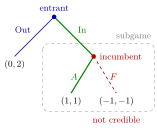
In the figure (the entry game below), the incumbent's decision after In is a subgame of its own. There Accommodate gives the incumbent and Fight gives , so the only Nash equilibrium of the subgame is , and the threat to play is not credible. The profile (Out, ) is a Nash equilibrium of the whole game but prescribes in this subgame, so it is not subgame perfect; the green path is the unique SPNE (In, ).
An SPNE is a profile of complete strategies, not a path of play. In the plain entry game each player has a single decision node, so (In, ) is already a complete strategy profile and the SPNE. In larger games, where a player moves at several information sets (as player 1 does in the outside-option example below), writing only the path of play does not specify an SPNE; the answer must state what every player does at every information set, including those off the equilibrium path.
The refinement has bite only when the game has subgames other than itself. When information sets prevent this (for example, an uninformed player moving after a private move), Nash equilibria with implausible behaviour can survive; perfect Bayesian equilibrium addresses this with beliefs.
Key Results
- SPNE Nash equilibria; the inclusion can be strict.
- In a finite game of perfect information, the pure-strategy SPNE are exactly the profiles found by backward induction; a pure-strategy SPNE exists. Without Nature, distinct payoffs for each player at different terminal nodes ensure uniqueness. With Nature, first average at chance nodes; a unique maximizing action at every player node in the backward calculation ensures uniqueness.
- Every finite extensive-form game with perfect recall has an SPNE, possibly in mixed or behavioural strategies: apply the Nash existence theorem to the smallest subgames, replace each by its equilibrium payoffs, and repeat (generalized backward induction).
- Different equilibria of a subgame can lead to different SPNE of the whole game.
- If the only subgame is itself, SPNE and Nash equilibrium coincide.
Examples
Entry game. Out gives to (entrant, incumbent); after In, Accommodate gives and Fight . Pure Nash equilibria: (In, ) and (Out, ). In the subgame after In, the incumbent's only Nash equilibrium is (), so (Out, ) is not subgame perfect: fighting is a non-credible threat. Given , the entrant prefers In (). The unique SPNE is (In, ).
Outside option. Player 1 chooses Out, giving , or In, after which both play the simultaneous game
The subgame has three Nash equilibria: , , and a mixed one in which player 2 plays with probability (from ) and player 1 plays with probability (from ), giving payoffs . Comparing each with Out's payoff for player 1:
- : , SPNE (In , ), outcome ;
- : , SPNE (Out , ), outcome ;
- mixed: , SPNE (Out with , ), outcome .
Player 1's strategy lists her subgame action even when she chooses Out.
Prerequisites
Related Concepts
- Backward Induction
- Sequential Rationality
- Forward Induction
- One-Stage Deviation Principle
- Perfect Bayesian Equilibrium
- Equilibrium Path
Sources
- Game Theory · Week 3
Aliases: SPNE, SPE, subgame-perfect equilibrium, subgame perfect equilibrium, subgame perfection, subgame perfect Keywords: non-credible threat, credible threat, Selten, generalized backward induction, equilibrium refinement, entry game, outside option Symbols: gamma, sigma, subset
Last updated: 27 October 2026 11:52
Subgame-Perfect Nash EquilibriumFolk TheoremForward InductionGrim Trigger StrategyMultistage GameOne-Stage Deviation PrinciplePerfect Bayesian EquilibriumRepeated GameSubgameNash EquilibriumStrategy in an Extensive-Form GameBackward InductionSequential RationalityEquilibrium Path