Nash Equilibrium in Mixed Strategies
Definition
In a finite normal-form game with players , a profile of mixed strategies with is a Nash equilibrium if, for every player and every ,
Equivalently, for every , where is the best-response correspondence extended to mixed strategies of the opponents.
Interpretation
The definition is the Nash equilibrium condition applied to the mixed extension of the game: no player can raise her expected payoff by a unilateral change of mixture. In the belief interpretation, describes player 's correct conjecture about her opponents, and each player best responds to that conjecture.
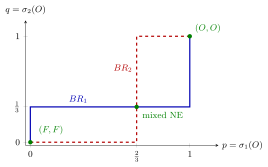
The figure draws both best-response correspondences of the Battle of the Sexes example, with across and up. Player 1 plays () when , () when , and any at ; player 2 switches at in the same way. A Nash equilibrium is a point that lies on both graphs, so the three crossings are the three equilibria: , and the mixed profile , . The jump of sits at a value set by player 2's mixture, and the jump of at one set by player 1's, which is why each player's equilibrium probability is fixed by the opponent's indifference.
Each player chooses a mixture that maximizes her own expected payoff against the opponents' mixtures. To compute a fully mixed equilibrium of a game, however, player 1's indifference equation constrains player 2's probability, and player 2's equation constrains player 1's. When these equations are nontrivial, they determine the probabilities. They need not have unique solutions in a degenerate game: if every payoff is zero, both equations are identities and every pair of mixtures is an equilibrium.
Key Results
- Every pure-strategy Nash equilibrium is a mixed-strategy Nash equilibrium with degenerate mixtures.
- It suffices to check pure deviations: is a Nash equilibrium if and only if for all and all .
- Every pure strategy in the support of earns exactly against , and no pure strategy earns more (the indifference principle).
- A pure strategy that is strictly dominated (by a pure or a mixed strategy) has probability in every mixed-strategy Nash equilibrium.
- Every finite game has at least one Nash equilibrium in mixed strategies (Nash existence theorem).
Examples
Matching Pennies. Player 1 wins on a match and loses otherwise; player 2 gets the negative. There is no pure equilibrium: at every cell one player wants to switch. If player 2 plays with probability , player 1 is indifferent when , so ; symmetrically . The unique Nash equilibrium is , with payoff to both.
Battle of the Sexes. Payoffs are at , at , and otherwise. Let and .
- Player 1 indifferent: , so .
- Player 2 indifferent: , so .
The game has three Nash equilibria: , and the mixed profile , . In the mixed one each player's expected payoff is (player 1: ; player 2: ), which is lower than either player's payoff in both pure equilibria. The mixed equilibrium is therefore not Pareto efficient: miscoordination occurs with probability .
Prerequisites
Related Concepts
- Indifference Principle for Mixed Strategies
- Nash Existence Theorem
- Chicken Game
- Harsanyi Purification Theorem
- Pareto Efficiency
- Battle of the Sexes
- Matching Pennies
Sources
- Game Theory · Week 2
Aliases: mixed-strategy Nash equilibrium, mixed Nash equilibrium, MSNE, mixed-strategy equilibrium, equilibrium in mixed strategies Keywords: mixed equilibrium, Matching Pennies, Battle of the Sexes, σ*, BR_i(σ_-i) Symbols: delta, element of, sigma
Last updated: 27 October 2026 11:52
Nash Equilibrium in Mixed StrategiesChicken GameHarsanyi Purification TheoremIndifference Principle for Mixed StrategiesMatching PenniesNash Existence TheoremMixed StrategyNash EquilibriumBest-Response CorrespondencePareto EfficiencyBattle of the Sexes