Weakly Dominant Strategy
Definition
Let be player 's strategy set and the set of strategy profiles of the other players in a normal-form game with payoffs . A strategy weakly dominates if, for all ,
with strict inequality for at least one . The strategy is weakly dominant if it weakly dominates every other strategy of player . In a Bayesian game the same definition is applied type by type: for each type, the action must do at least as well against every action profile of the opponents, and strictly better against at least one.
Interpretation
A weakly dominant strategy is never worse than any alternative, whatever the others do, and is strictly better against at least one of their choices. A player who uses it needs no beliefs about the opponents: it is a best response to every .
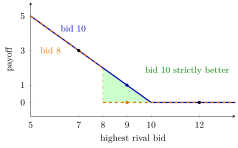
In the figure (the truthful-bidding example below), a bid that beats the highest rival bid earns minus that rival bid, and a losing bid earns . Bidding and bidding give the same payoff when the highest rival bid is below (for example at ) or above (for example at ), and bidding is strictly better in between ( versus at ). That is weak dominance: never worse, and strictly better against some rival bids.
The difference from a strictly dominant strategy is that ties are allowed. Strict dominance requires a strictly higher payoff against every ; weak dominance only requires "never worse, sometimes better". Every strictly dominant strategy is therefore weakly dominant, but not conversely.
Ties have consequences. A weakly dominated strategy can still be a best response to some opponent profile, so it can appear in a Nash equilibrium, and iterated deletion of weakly dominated strategies can give different results depending on the order of deletion. A leading application is the second-price auction, where bidding one's own value is weakly (not strictly) dominant.
Key Results
- Strictly dominant weakly dominant; the converse fails (see the example below).
- Under this definition a player has at most one weakly dominant strategy: two strategies cannot each weakly dominate the other, because each would need a strict inequality the other rules out.
- If every player has a weakly dominant strategy, the profile of these strategies is a Nash equilibrium. It need not be the only Nash equilibrium.
- A Nash equilibrium may involve weakly dominated strategies; it can never involve strictly dominated ones.
- In a second-price sealed-bid auction with private values, bidding (one's valuation) is weakly dominant; in a first-price auction, with at least two bidders, a positive-value type has no weakly dominant bid against unrestricted nonnegative rival bids. A zero-value type is an exception: bid always earns and weakly dominates every positive bid.
Examples
A weakly but not strictly dominant strategy. Consider
For the row player, gives against and against , so weakly dominates and is weakly dominant, but not strictly dominant. The same holds for for the column player. Both and are Nash equilibria: at neither player gains by deviating alone, although both use weakly dominated strategies. Deleting weakly dominated strategies selects .
Truthful bidding. A bidder with value in a second-price auction compares bidding with bidding . If the highest rival bid is , bidding wins and gives , while bidding loses and gives . If the highest rival bid is or , both bids give the same payoff ( and ). So bidding is never worse and sometimes strictly better.
Prerequisites
Related Concepts
Sources
- Game Theory · Week 6
Aliases: weakly dominant, weakly dominates Keywords: weak dominance, weakly dominated strategy, dominant-strategy equilibrium, truthful bidding Symbols: element of, theta
Last updated: 27 October 2026 11:52
Weakly Dominant StrategyEnglish AuctionSecond-Price AuctionStrictly Dominant StrategyNormal-Form GameBest ResponseStrictly Dominated StrategyNash Equilibrium