Common-Value Auction
Definition
In a common-value auction the object has the same value for every bidder, but no bidder knows . Each bidder privately observes a signal that is informative about , and her payoff from winning at price is . Bidder 's expected value therefore depends on the other bidders' signals as well as on her own.
A two-bidder example with this structure has , where bidder observes only her own component , and are independent.
Interpretation
The contrast with a private-value auction is about information, not about who values the object more. With private values, learning a rival's signal would not change one's own valuation; with a common value it would. Classic examples are drilling rights to an oil field of unknown size, or a jar of coins whose total is estimated by eye.
In the additive example below, the equilibrium bids are strictly increasing, so a bidder wins when her signal exceeds the rival's. Because the common value increases with the rival's signal, winning lowers its conditional expected value for interior own signals. Common values make the rival's information relevant; the direction of this update depends on the signal model. A rational bidder therefore bids on the basis of the conditional expectation of given her signal and given that she wins (or, in a second-price auction, given that she is just tied). Ignoring this produces the winner's curse.
Truthful bidding results for private values do not carry over directly. In a second-price auction the case argument for bidding "one's value" fails, because one's value is not known; the equilibrium bid must instead be computed as a Bayesian Nash equilibrium.
Key Results
- In the additive uniform example below, for and increasing equilibrium bids, . The conditioning event has positive probability in this range.
- For with i.i.d. : the symmetric BNE of the second-price auction is , and that of the first-price auction is .
- In that example both formats give expected revenue .
- The Dutch–first-price equivalence holds with common values; the English–second-price equivalence can fail with three or more bidders, because drop-out prices reveal signals.
Examples
Take with independent and uniform on .
Second-price. Let bidder 2 bid . Bidder 1 with signal who bids wins when and pays , so her expected payoff (written because is the common value) is
The integrand is positive for and negative for , so the payoff is maximized at , i.e. . Revenue is .
First-price. Let bidder 2 bid . Bidder 1 with signal bidding wins when , with expected payoff
maximized at . Revenue is .
Numbers. With , , but . The first-price bid leaves an expected margin of when winning.
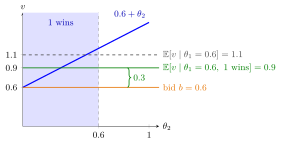
The figure fixes bidder 1's signal at , so the value is . Averaged over all it is , but in the first-price equilibrium bidder 1 wins only in the shaded region , where the average value is . Against the rival strategy , bidding wins for sure and pays exactly the unconditional expected value, so its expected profit is . This is worse than the equilibrium bid , whose winning probability and conditional margin give expected profit . If both bidders instead naively bid , winning with signal means , so paying gives conditional expected profit , a winner's curse.
Prerequisites
- Private-Value Auction
- Bayesian Nash Equilibrium
- Conditional Expectation Given an Event
- Uniform Distribution
Related Concepts
Sources
- Game Theory · Week 6
Aliases: Common Value Auction, pure common-value auction, common-values auction Keywords: private signal, interdependent values, wallet game, v = theta_1 + theta_2, conditioning on winning Symbols: integral, theta
Last updated: 27 October 2026 11:52
Common-Value AuctionWinner's CursePrivate-Value AuctionBayesian Nash EquilibriumConditional Expectation Given an EventUniform DistributionSecond-Price AuctionFirst-Price AuctionEnglish Auction