Market for Lemons
Definition
The market for lemons (Akerlof, 1970) is a model of trade in which each seller knows the quality of her good, her type, while buyers know only its distribution. A seller of quality values the good at and a buyer at , so every trade would create surplus. Because the price cannot depend on , a seller offers the good if and only if , and buyers value an offered good at its conditional expectation
With competing buyers, an equilibrium price satisfies , and the goods traded are those with . A "lemon" is a low-quality good.
Interpretation
The model is the textbook case of adverse selection. Lowering the price drives out the best goods first, which lowers the average quality on offer, which justifies a still lower price. The market can shrink to the lowest qualities or disappear altogether, even though buyers value every car more than its owner does.
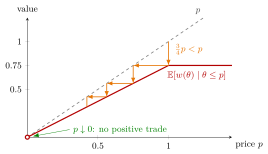
The figure draws the complete-unravelling example ( uniform on , , ). At a price only cars with are offered, so buyers value an offered car at for , and for (red), which lies below the dashed line where value equals price. The orange staircase follows the spiral described above: start at , buyers will pay only , at that price the best remaining cars withdraw and buyers will pay only , and so on. For every positive price the red curve lies strictly below the price, so there is no positive-price equilibrium. Its right limit at zero is zero, shown by an open endpoint: at the offered set has probability zero, so this event-conditional mean is undefined. The limiting outcome has no positive trade.
The failure has nothing to do with dishonesty or irrationality. Everyone optimizes given the information available; the problem is that quality cannot be verified. Institutions such as warranties, inspections, dealer reputation and certification exist largely to restore that information, and costly signals can let high types separate themselves, as studied in signalling games.
A frequent error is to compute the buyers' value with the unconditional average quality. Buyers should average only over the cars actually offered at that price.
Key Results
- With two qualities and competing buyers, there is an equilibrium in which high quality trades if and only if the pooled value is at least the high type's reservation value .
- Otherwise the only equilibrium has a price at which only low qualities are offered, and the gains from trade on high-quality goods are lost.
- With a continuum of qualities, trade can unravel completely.
- An equilibrium excluding positive-surplus trades is not Pareto efficient: every unsold car would be worth more to a buyer than to its owner. Full-trade pooling can instead be efficient when the pooled value is high enough.
Examples
Two qualities: only lemons trade. Half the cars are good, half are lemons. Sellers value a good car at 2500 and a lemon at 1000; buyers value them at 3000 and 1200.
- If both types were offered, buyers would pay at most , so good cars cannot be sold at any price buyers accept.
- At any price in only lemons are offered, worth 1200 to buyers; competition among buyers sets .
Only lemons trade, and the surplus on each good car is lost. Good cars would trade if and only if their share satisfies , i.e. .
Complete unravelling. Let follow the uniform distribution on , with and . At a price sellers with offer, so and buyers value an offered car at . For all cars are offered and are worth to buyers. No positive price can be an equilibrium: no trade, although every car is worth 50% more to buyers than to sellers.
Prerequisites
Related Concepts
Sources
- Game Theory · Week 5
Aliases: lemons market, lemons problem, Akerlof's market for lemons, Akerlof model, lemons model Keywords: Akerlof, used cars, quality uncertainty, market unravelling, only lemons trade, average quality price Symbols: element of, mu, theta
Last updated: 27 October 2026 11:52
Market for LemonsAdverse SelectionTypeConditional Expectation Given an EventUniform DistributionBayesian Nash EquilibriumSignalling GameSeparating EquilibriumPareto Efficiency