Strictly Dominant Strategy
Definition
In a normal-form game, a strategy is strictly dominant for player if, for every and every ,
Equivalently, strictly dominates every other strategy of player , so every other strategy is a strictly dominated strategy.
A profile in which every is strictly dominant is a strictly dominant strategy equilibrium.
Interpretation
A strictly dominant strategy is the best choice regardless of what the others do, so a rational player needs no belief about the opponents to choose it. A prediction based on dominant strategies requires only that each player is rational, not that rationality is common knowledge.
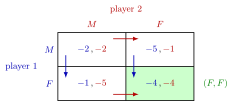
In the figure, the blue arrows compare player 1's payoffs within each column: switching from to raises her payoff from to against and from to against . The red arrows make the same comparison for player 2 within each row. Every arrow points to whatever the opponent does, so is strictly dominant for both players, and the shaded cell is the strictly dominant strategy equilibrium, even though would give both players more.
The concept is demanding: the same strategy must be strictly best against every opponent profile. Many games have no strictly dominant strategy for at least one player. A frequent misunderstanding is to treat "best against what the opponent actually does" as dominance; that is only a best response.
Dominant strategies do not guarantee a good outcome. In the Prisoner's Dilemma both players use their dominant strategy, and both would be better off if both deviated.
Key Results
- A player has at most one strictly dominant strategy: if and were both strictly dominant, each would give a strictly higher payoff than the other.
- If is strictly dominant, then is the unique best response to every (and to every belief).
- A strictly dominant strategy equilibrium, if it exists, is unique, and it is the unique Nash equilibrium of the game.
- Iterated elimination of strictly dominated strategies reaches it in a single round.
- Existence is not guaranteed: in Battle of the Sexes and in Matching Pennies no player has a strictly dominant strategy.
- The equilibrium may fail to be Pareto efficient.
Examples
1. Prisoner's Dilemma. With payoffs , , , :
So is strictly dominant for player 1, and by symmetry for player 2. The strictly dominant strategy equilibrium is with payoffs , although gives to both.
2. No dominant strategy.
Player 1's best choice is against and but against ; player 2's best choice is against but against . Neither player has a strictly dominant strategy, even though is strictly dominated by .
3. Cournot. In a Cournot duopoly a firm's best quantity falls as the rival's quantity rises, so no single quantity is best against every rival quantity.
Prerequisites
Related Concepts
- Nash Equilibrium
- Pareto Efficiency
- Weakly Dominant Strategy
- Iterated Elimination of Strictly Dominated Strategies
- Prisoner's Dilemma
Sources
- Game Theory · Week 1
Aliases: strictly dominant action Keywords: strictly dominant strategy equilibrium, dominant-strategy equilibrium, strictly dominates every other strategy, Prisoner's Dilemma, Fink, unique best response Symbols: element of
Last updated: 22 October 2026 19:04
Strictly Dominant StrategyPrisoner's DilemmaWeakly Dominant StrategyStrictly Dominated StrategyNormal-Form GameNash EquilibriumPareto EfficiencyIterated Elimination of Strictly Dominated Strategies