Matching Pennies
Definition
Matching Pennies is a two-player normal-form game in which each player shows a coin, (heads) or (tails), simultaneously. Player 1 wins if the coins match and player 2 wins if they differ; the winner gets and the loser :
The game is zero-sum: for every profile .
Interpretation
Matching Pennies is the simplest game of pure conflict in which being predictable is costly. If player 2 knew player 1's choice, she would pick the other side and win; the same holds the other way round. It models situations such as a penalty kick (shoot left or right, dive left or right) or a tax inspection (evade or comply, inspect or not).
There is no Nash equilibrium in pure strategies: in every cell the loser wants to switch. The game therefore shows why mixed strategies are needed. In the equilibrium each player randomizes –, which leaves the opponent with nothing to exploit.
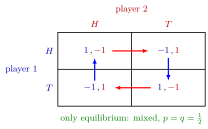
In each cell the arrow shows the loser's profitable switch. At player 2 moves to (red, along the row); at player 1 moves to (blue, down the column); at player 2 moves back to ; at player 1 moves back to . The four arrows close into a cycle, so play never settles on a pure profile, and the only equilibrium is the mixed one in which both players play with probability .
The equilibrium probabilities are not chosen to maximize a player's own payoff; any mixture is a best response once the opponent mixes equally. They are pinned down by the requirement that the opponent is indifferent. If player 2 played with probability , player 1's unique best response would be the pure strategy , and that cannot be part of an equilibrium.
Drawn as a game tree (Week 3), player 2's two decision nodes form one information set, because she does not see player 1's coin. If she could see it, she would always win.
Key Results
- Matching Pennies has no pure-strategy Nash equilibrium.
- No strategy is dominated, so iterated elimination of strictly dominated strategies removes nothing.
- It has a unique Nash equilibrium in mixed strategies, in which both players play with probability ; each player's expected payoff is . The equilibrium is not strict: against the opponent's mixture, , and every mixture give the same payoff.
- The best-response correspondence of player 1 is if , if and every mixture if , where is player 2's probability of ; player 2's is the mirror image. The two graphs cross only at .
- The equilibrium mixture guarantees each player an expected payoff of whatever the opponent does.
- The game shows that existence of a pure equilibrium cannot be guaranteed, while the Nash existence theorem guarantees an equilibrium in mixed strategies.
Examples
No pure equilibrium. At and player 2 loses and gains by switching; at and player 1 loses and gains by switching. No cell survives.
The mixed equilibrium. Let player 1 play with probability and player 2 with probability . By the indifference principle,
which are equal only at ; symmetrically . With , player 1's payoff is for every .
Why other mixtures fail. Suppose player 2 plays with probability . Then gives player 1 and gives , so her unique best response is the pure strategy . Against , player 2's best response is , which contradicts . The same argument rules out every , and symmetrically every .
An unbalanced version. Suppose player 1 wins (and player 2 loses ) at , all other payoffs unchanged. Player 1 is indifferent when , so . Player 2 is indifferent when , so . Player 1's expected payoff is . The larger prize at changes player 2's mixture, who now avoids , and also player 1's: she plays less often than before, because her probability is set by player 2's payoffs, not her own.
Prerequisites
- Normal-Form Game
- Mixed Strategy
- Nash Equilibrium in Mixed Strategies
- Indifference Principle for Mixed Strategies
Related Concepts
- Nash Existence Theorem
- Best-Response Correspondence
- Information Set
- Battle of the Sexes
- Chicken Game
Sources
- Game Theory · Week 2 (placement provisional; not yet checked against the lecture slides)
Aliases: matching pennies game, game of matching pennies Keywords: zero-sum game, no pure-strategy equilibrium, heads or tails, mix one half each, unpredictability, penalty kick Symbols: sigma
Last updated: 14 October 2026 08:21
Matching PenniesNormal-Form GameMixed StrategyNash Equilibrium in Mixed StrategiesIndifference Principle for Mixed StrategiesNash Existence TheoremBest-Response CorrespondenceInformation SetBattle of the SexesChicken Game