Second-Price Auction
Definition
In a second-price sealed-bid auction, each of bidders submits a bid simultaneously and privately. The highest bidder wins (ties broken at random) and pays the second-highest bid, that is, the highest bid among the other bidders; losers pay nothing. In a private-value auction with valuation , bidder 's payoff is if she wins and otherwise.
Interpretation
The winner's own bid decides only whether she wins, not what she pays. Let be the highest rival bid. Winning is worth , which is positive exactly when . Bidding wins in precisely those cases, so no other bid can do better.
- Bidding gives a lower expected payoff than truth-telling when : she wins for sure for , or with the tie-winning probability at , and pays .
- Bidding gives a lower expected payoff when : she loses for sure for , or loses with positive probability at , instead of winning a positive surplus. At the surplus is zero, so ties do not change the payoff.
Hence truthful bidding is a weakly dominant strategy; it is not strictly dominant, because against many rival bids (for instance far above or far below ) other bids give the same payoff. The argument uses no beliefs about the rivals and no distributional assumptions, but it does rely on private values: with common values, a rival's bid carries information about one's own value.
Key Results
- With private values, is weakly dominant for every type, so the truthful profile is a Bayesian Nash equilibrium for any distribution of values.
- In the truthful equilibrium the highest-value bidder wins and pays the second-highest valuation.
- With i.i.d. , expected revenue is the expectation of the second-highest order statistic: , the same as in the first-price auction.
- The truthful equilibrium is not the only BNE: for with values on , "bidder 1 bids , bidder 2 bids " is also an equilibrium, but it uses weakly dominated strategies and can give the object to the lower-value bidder.
- The English auction with private values leads to the same outcome as the truthful second-price equilibrium.
Examples
Case check. A bidder values the object at . Compare bids , and against highest rival bid :
| bid | bid | bid | |
|---|---|---|---|
| (loses) | |||
Bidding is never worse than or and is strictly better against (versus ) and (versus ).
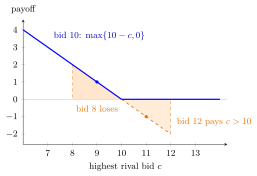
The figure draws the payoff of the bidder in the case check, value , as a function of the highest rival bid . Truthful bidding earns . The shaded interiors show the lost gain for when bidding (e.g. at ), and the loss for when bidding (e.g. at ). Random ties also matter at the alternative bids: with one rival, gives bid expected payoff versus from truth-telling, and gives bid expected payoff versus from truth-telling. Thus the payoff differences occur on the intervals and , including the tie endpoints; elsewhere all three bids give the same payoff.
Revenue with three bidders. With and values, expected revenue is . For a bidder of type the expected payment is (she pays when she wins, that is when , and nothing otherwise) with the highest of the two rival values, which has density on : . Averaging over and summing over the three bidders gives , as stated.
Prerequisites
Related Concepts
Sources
- Game Theory · Week 6
Aliases: second-price sealed-bid auction, Vickrey auction, SPA, SPSB auction Keywords: truthful bidding, bid your value, highest losing bid, second-highest bid Symbols: integral, theta
Last updated: 27 October 2026 11:52
Second-Price AuctionEnglish AuctionRevenue Equivalence TheoremPrivate-Value AuctionWeakly Dominant StrategyBayesian Nash EquilibriumOrder StatisticFirst-Price AuctionCommon-Value Auction