System of Beliefs
Definition
In an extensive-form game, a system of beliefs assigns to every information set a probability distribution over the decision nodes in :
The number is the probability that the player who moves at assigns to being at node , given that has been reached. A strategy profile together with a system of beliefs is called an assessment .
Interpretation
At an information set with several nodes, a player knows that one of them has been reached but not which. Expected continuation payoffs are calculated by weighting the payoffs at the different nodes. Beliefs supply those weights. The best action can depend on them, although an action that is best at every node can be chosen without knowing the precise belief. They make it possible to define sequential rationality at every information set, including information sets that equilibrium play never reaches.
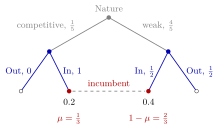
In the figure (the entry example below), the incumbent's information set after entry is reached with probability through the competitive type and through the weak type. The belief divides these weights by their total , giving on the competitive node and on the weak one; these are the weights the incumbent uses to compare its actions.
Beliefs describe uncertainty about the history leading to the information set. With perfect recall, this concerns moves the player did not observe, such as Nature's type draw or a rival's action. Without perfect recall it can also concern her own forgotten actions. They are a conditional probability of the node given the information set. A singleton information set carries the trivial belief , so beliefs only matter at information sets with two or more nodes.
A system of beliefs is part of the description of an equilibrium, not a consequence of payoffs alone. Equilibrium concepts then restrict it: on the equilibrium path, beliefs must follow from the strategies by Bayes' rule; off the path the restriction is weaker, and different beliefs can support different equilibria.
Key Results
The on-path conditional-probability formula uses the usual setting in which a play cannot visit two nodes of the same information set, as guaranteed by perfect recall.
- A system of beliefs specifies one distribution per information set; at a two-node information set it reduces to one number , with on the other node.
- At an information set reached with positive probability under , beliefs consistent with are uniquely determined by Bayes' rule.
- At an information set reached with probability under , Bayes' conditional ratio is undefined. In the weak perfect Bayesian equilibrium convention used here, Bayes' rule alone leaves any probability distribution admissible; the assessment must still satisfy sequential rationality. A singleton has only the belief .
- In a signalling game, the receiver has one information set per message, and the beliefs are the posterior probabilities of the sender's types after each message.
Examples
Entry with unknown type. Nature makes an entrant competitive with probability or weak with probability ; the incumbent sees entry but not the type. Its information set after entry has two nodes, and a belief is a number . If the competitive type always enters and the weak type enters with probability , consistency requires .
Signalling with two messages. A sender of type or sends a message , and the receiver observes only . A system of beliefs is a pair , for example . If both types send , the information set after is never reached, and any value of is admissible as a belief.
Prerequisites
Related Concepts
- Bayes Rule for Beliefs
- Perfect Bayesian Equilibrium
- Sequential Rationality
- Signalling Game
- Equilibrium Path
Sources
- Game Theory · Week 7
Aliases: belief system Keywords: beliefs mu(x), assessment, belief at an information set, off-path beliefs, posterior belief, entry game Symbols: element of, mu, sigma, sum
Last updated: 27 October 2026 11:52
System of BeliefsBayes Rule for BeliefsPerfect Bayesian EquilibriumPooling EquilibriumExtensive-Form GameInformation SetBayesian GameConditional ProbabilitySequential RationalitySignalling GameEquilibrium Path