Bayesian Game
Definition
A (static) Bayesian game is a tuple
where is the set of players, is player 's action set, is her set of types, gives her payoff for action profile and type profile , and is a common prior on . The timing is: Nature draws from ; each player learns her own ; players choose actions simultaneously; payoffs are . All components of the tuple are common knowledge. A pure strategy is a map .
Interpretation
A Bayesian game extends a normal-form game to private information. Without types there would be nothing a player knows that the others do not; with types, each player must think about what every possible type of every opponent would do.
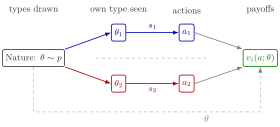
The figure follows the timing in the definition. Nature draws from the common prior ; player 1 sees only and player 2 only , and the dashed line between the two rows marks that neither sees the other's type. Each action is produced by a strategy applied to the player's own type, while the payoff can depend on the whole type profile, shown by the dashed arrow from Nature.
Given strategies of the others, type evaluates action by her interim expected payoff
Two misunderstandings are common. First, a strategy is not the action actually taken; it must specify what each type would do, because the others' optimal choices depend on all of them. Second, payoffs may depend on the others' types as well as one's own (interdependent values, as with car quality in the market for lemons); "private values" is the special case .
Key Results
- With finite sets, player has pure strategies.
- If every is a singleton, the Bayesian game is an ordinary normal-form game of complete information.
- The equilibrium concept is the Bayesian Nash equilibrium: each type best responds given her beliefs.
- The game can equivalently be drawn as an extensive-form game in which Nature moves first, the Harsanyi transformation.
Examples
Contribution game. Two neighbours, , choose (contribute or decline). A shared good worth 1 to each is provided if at least one contributes; contributing costs . So
Types are , drawn independently with probability each. Each player has pure strategies. A high-cost type gets from contributing and at least 0 from not contributing, so is a strictly dominant action for her, whatever the other does. The low-cost type's choice depends on what she expects the other to do; this is solved on the Bayesian Nash equilibrium page.
Auctions. In a sealed-bid auction each bidder's type is her valuation, her action is a bid, and payoffs depend on all bids; see the first-price auction.
Prerequisites
Related Concepts
Sources
- Game Theory · Week 5
Aliases: game of incomplete information, static Bayesian game, Bayesian normal-form game, game with incomplete information, incomplete-information game Keywords: (N, A_i, Theta_i, v_i, p), types and common prior, incomplete information, type-contingent strategy, interim expected payoff, contribution game Symbols: element of, real numbers, sum, theta
Last updated: 17 October 2026 21:53
Bayesian GameBayesian Nash EquilibriumHarsanyi TransformationPrivate-Value AuctionSignalling GameSystem of BeliefsTypeCommon PriorNormal-Form GameExpectationMarket for LemonsFirst-Price Auction