Best Response
Definition
In a normal-form game , fix the other players' strategies . A strategy is a best response of player to if, for every ,
More generally, if player holds a belief , a probability distribution over (finite here), then is a best response to if it maximizes the expected payoff over .
Interpretation
A best response is what a rational agent does once a belief about the others has been formed: the opponents' play is treated as given and the player solves an ordinary maximization problem. With a probabilistic belief this is expected payoff maximization.
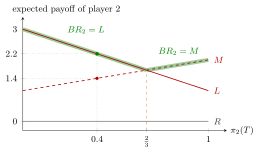
The figure uses the matrix of Example 1 below. If player 2's belief puts probability on , her expected payoffs are from , from and from . The best response is the strategy on the highlighted upper envelope: while and above , where the two lines cross, with both optimal at ; is never a best response. At the belief of Example 2 the comparison is against .
A best response is defined relative to ; it may change when changes. If the belief is wrong, the chosen strategy may not be optimal against what is actually played. Nash equilibrium is the situation in which every player best responds to the strategies the others actually use.
Best responses need not be unique: with ties, all maximizers are best responses, collected in the best-response correspondence .
Key Results
- If is finite, a best response exists for every . If is compact and is continuous, existence follows from the extreme value theorem on compact sets; otherwise a best response may fail to exist (undercutting in a Bertrand duopoly).
- A strictly dominated strategy is never a best response, to any or any belief.
- A strictly dominant strategy is the unique best response to every .
- If is an interval and is differentiable and concave, every interior point satisfying the first-order condition is a best response. On a closed bounded interval, continuity guarantees an optimum; if no interior point is stationary, compare the endpoints. On an open or unbounded interval, a best response may fail to exist: the payoff on has no maximizer.
Examples
1. Matrix game. Payoffs :
Player 1 compares down each column: the best response to is (), to is (), to is (). Player 2 compares along each row: the best response to is (), to is ().
2. Belief. If player 2 believes player 1 plays with probability and with probability , the expected payoffs are : , : , : . The best response to this belief is .
3. Cournot. Consider nonnegative quantities in a Cournot duopoly, using the linear price formula and unit cost . Firm 1's profit is . Its second derivative in is , so the constrained maximizer is . The interior first-order condition applies when ; at the best response is . Against it is .
Prerequisites
Related Concepts
Sources
- Game Theory · Week 1
Aliases: best reply, BR Keywords: best response to s_{-i}, best response to a belief, belief about opponents, reaction to the rival's choice, never a best response Symbols: element of, partial, pi, sum
Last updated: 27 October 2026 11:52
Best ResponseBattle of the SexesBayesian Nash EquilibriumBertrand DuopolyBest-Response CorrespondenceCournot DuopolyMedian Voter TheoremNash EquilibriumSequential RationalityStackelberg CompetitionWeakly Dominant StrategyNormal-Form GameRational AgentExpected Payoff Maximization