Bayesian Nash Equilibrium
Definition
In a Bayesian game , a profile of pure strategies with is a Bayesian Nash equilibrium (BNE) if for every player , every type with and every action ,
That is, each type's prescribed action is a best response to the other players' type-contingent strategies, given that type's beliefs. Mixed BNE are defined in the same way with mixed actions for each type.
Interpretation
A BNE is a Nash equilibrium in which "player" is replaced by "player-type". Each type maximizes a conditional expectation of her payoff given her own type, and the expectation is taken over the others' types and hence over their type-dependent actions. Players need not know what the others will actually do; they know the others' strategies, the maps from types to actions.
The condition is imposed type by type (interim), but it is equivalent to an ex ante condition: is a BNE if and only if it is a Nash equilibrium of the normal-form game whose strategies are the maps and whose payoffs are ex ante expected payoffs , provided every type has positive probability. Maximizing an average with positive weights is the same as maximizing each term.
A common mistake is to check only the type that is "actually realized". Every type must be optimizing, because the other players' incentives depend on what the unrealized types would do.
Key Results
- If every is a singleton, a BNE is a Nash equilibrium of the underlying game.
- A finite Bayesian game has at least one BNE, possibly in mixed strategies, by the Nash existence theorem applied to the ex ante game.
- If an action is strictly dominant for a type that has positive probability, that type plays it in every BNE.
- In a BNE of a game with a sequential structure, off-path behaviour need not be optimal; sequential versions such as perfect Bayesian equilibrium add this.
Examples
Contribution game. Each player chooses (contribute) or (decline); the good (worth 1 to each) is provided if at least one contributes; contributing costs , independently low with probability .
- High-cost type: gives , gives at least 0, so she plays .
- Low-cost type: gives . gives 1 times the probability that the other contributes, which is at most , because the other's high type never contributes.
- With : gives at most , so the low type contributes.
The unique BNE is , for both players; the good is provided with probability .
Changing the prior. The profile in step 3 remains a BNE if and only if . For a low-cost type would rather free-ride on the other's low type; then, for example, "only player 1's low type contributes" is a BNE (player 2's low type gets from , and player 1's low type gets from ).
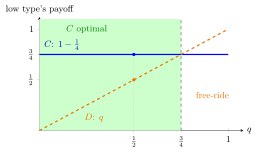
The figure fixes the other player's strategy at the candidate profile, so that her low type contributes and her high type declines. A low-cost type then gets from and from . At the line lies above the line, which is step 3; the shaded region is where the profile remains a BNE, and to the right of the threshold declining and free-riding pays more.
Prerequisites
Related Concepts
Sources
- Game Theory · Week 5
Aliases: BNE, Bayesian equilibrium, Bayes–Nash equilibrium, Bayes-Nash equilibrium Keywords: type-contingent best response, interim expected payoff, ex ante normal form, equilibrium with private information, free-riding with private costs Symbols: element of, sum, theta
Last updated: 22 October 2026 19:04
Bayesian Nash EquilibriumAdverse SelectionCommon-Value AuctionFirst-Price AuctionHarsanyi Purification TheoremPerfect Bayesian EquilibriumPrivate-Value AuctionRevenue Equivalence TheoremSecond-Price AuctionBayesian GameNash EquilibriumBest ResponseConditional Expectation Given an EventMarket for Lemons