Median Voter Theorem
Theorem
Consider a policy interval and a continuum of voters whose ideal points have a continuous, strictly increasing cumulative distribution function on , with median , so . Each voter votes for the candidate whose platform is closest to her ideal point (a voter at equal distance splits her vote equally). Two candidates choose platforms simultaneously; the candidate with more votes wins, and a tie is broken by a fair coin. Each candidate cares only about winning: payoff for a win, for a loss, so in expectation for a tie.
Then the game has a unique Nash equilibrium, . Normalizing the median to gives .
Interpretation
The result goes back to Hotelling's (1929) model of firms locating on a line and Downs's (1957) model of party competition. A candidate's vote share depends only on which side of the midpoint between the two platforms each voter lies, so moving towards the rival, while staying on one's own side, captures voters. The only position that cannot be beaten is the median.
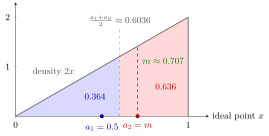
The figure draws the skewed-electorate example, with density and median . The rival stands at and candidate 1 deviates to . Every voter left of the midpoint is closer to , so candidate 1's vote share is the blue area and she loses. Moving to the right shifts the midpoint and grows the blue area, but it reaches only when .
Each assumption matters: one policy dimension, single-peaked preferences (here: distance-based), exactly two office-seeking candidates, no abstention and no entry. With three or more candidates, or with candidates who care about the policy itself, convergence to the median generally fails.
The prediction is the median, not the mean, of the ideal points; the two differ for a skewed distribution. Convergence is also not a welfare optimum in the location version (see the beach example).
Key Results
- is an equilibrium: each candidate gets ; a deviation to gives candidate 1 the vote share , a sure loss (symmetrically for ).
- No other profile is an equilibrium. If , either candidate wins outright by moving to . If and one candidate wins, the loser can copy the winner's platform and raise her payoff from to . If and they tie, then , and candidate 1 wins outright by moving to any point strictly between and .
- The best response to a rival at is the set of platforms in strictly between and the point , which win outright.
- Discrete version (Black): with an odd number of voters with single-peaked preferences, the median ideal point beats every other alternative in a pairwise majority vote.
Examples
Skewed electorate. Let on . The median solves , so , while the mean is . Both candidates locate at . If candidate 1 deviates to , the midpoint is and her share is .
Five voters. Ideal points ; the median is and the mean is . In a vote between and , the voters at (ideal point below the midpoint ) prefer , a majority of out of .
Beach vendors. Customers are uniformly distributed on and buy from the nearest vendor. In equilibrium both vendors stand at , with average walking distance . Locations and would halve this to , so the equilibrium is not efficient for the customers.
Prerequisites
Related Concepts
Sources
- Game Theory · Week 2
Aliases: median voter model, Hotelling–Downs model, Hotelling-Downs model, Downsian model Keywords: Hotelling, Downs, location game, single-peaked preferences, policy convergence, ice-cream vendors on a beach Symbols: element of, integral, real numbers, square root, subset
Last updated: 27 October 2026 11:52
Median Voter TheoremNash EquilibriumBest ResponseMedianCumulative Distribution FunctionBertrand DuopolyPareto EfficiencyNash Existence TheoremSymmetric Distribution