Nash Equilibrium
Definition
In a normal-form game , a pure-strategy profile is a Nash equilibrium if, for every player and every ,
Equivalently, is a best response to for every , that is, for the best-response correspondence . If every inequality is strict for , the equilibrium is strict.
Interpretation
At a Nash equilibrium no player can gain by changing strategy alone. Each player's belief about the others is correct, and each player acts optimally given that belief, so the profile is self-enforcing: once it is expected, nobody wants to leave it.
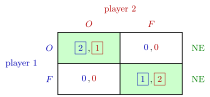
In the figure, player 1's payoff is boxed when it is the largest in its column and player 2's when it is the largest in its row. A cell with both payoffs boxed is a profile in which each strategy is a best response to the other, so neither player gains by moving alone: and are the pure Nash equilibria, while from or either player would switch.
Only unilateral deviations are tested. A profile that every player would like to leave together can still be an equilibrium, as in the Prisoner's Dilemma shows. Hence an equilibrium need not be Pareto efficient, and a profile that maximizes total payoff need not be an equilibrium.
Nash equilibrium does not require that strategies be dominant: each only needs to be optimal against , not against everything.
Key Results
- Best-response marking method (finite two-player games). In each column, mark player 1's highest payoff (all of them if tied); in each row, mark player 2's highest payoff (all of them if tied). A cell is a pure Nash equilibrium if and only if both of its payoffs are marked, since a marked first entry means and a marked second entry means .
- A strictly dominant strategy equilibrium is the unique Nash equilibrium.
- Every Nash equilibrium survives iterated elimination of strictly dominated strategies; in a finite game, if that procedure leaves one profile, it is the unique Nash equilibrium.
- A pure-strategy Nash equilibrium may not exist (Matching Pennies) or may not be unique (Battle of the Sexes). Every finite game has at least one Nash equilibrium in mixed strategies by the Nash existence theorem (Week 2).
Examples
1. Marking in Battle of the Sexes. Marked payoffs are shown in bold.
Column : player 1 prefers (); column : (). Row : player 2 prefers (); row : (). Both entries are marked in and : two pure Nash equilibria.
2. No pure equilibrium. In Matching Pennies (, mismatches ) player 1's marks are on the diagonal and player 2's off the diagonal, so no cell is marked twice.
3. Prisoner's Dilemma. With , , , , only is marked twice. At player 1 gains by deviating to (), so is not an equilibrium.
4. Cournot. In a Cournot duopoly with price and unit cost , solving and gives the unique equilibrium .
Prerequisites
Related Concepts
- Nash Equilibrium in Mixed Strategies
- Nash Existence Theorem
- Iterated Elimination of Strictly Dominated Strategies
- Pareto Efficiency
- Subgame-Perfect Nash Equilibrium
- Prisoner's Dilemma
- Battle of the Sexes
- Matching Pennies
Sources
- Game Theory · Week 1
Aliases: Nash Equilibrium in Matrix Games, NE, pure-strategy Nash equilibrium, Nash equilibrium in pure strategies, pure equilibrium, pure-strategy equilibrium, pure Nash equilibrium Keywords: no profitable unilateral deviation, best-response marking method, underlining best responses, s^*, self-enforcing profile, strict Nash equilibrium, Battle of the Sexes, Prisoner's Dilemma Symbols: element of
Last updated: 17 October 2026 21:53
Nash EquilibriumBattle of the SexesBayesian Nash EquilibriumBertrand DuopolyChicken GameCournot DuopolyEquilibrium PathExtensive-Form GameMedian Voter TheoremNash Equilibrium in Mixed StrategiesPrisoner's DilemmaStage GameSubgame-Perfect Nash EquilibriumTrigger StrategyBest ResponseBest-Response CorrespondenceNormal-Form GameNash Existence TheoremIterated Elimination of Strictly Dominated StrategiesPareto EfficiencyMatching Pennies