Harsanyi Purification Theorem
Theorem
Informal statement (Harsanyi, 1973). Let be a finite normal-form game with payoffs , and let be a Nash equilibrium in mixed strategies of . For consider the perturbed Bayesian game in which player 's payoff is
where the perturbation vector is player 's privately observed type, drawn from a distribution with a continuous density, independently across players. Then, for generic (more precisely, for every regular equilibrium ), there are equilibria of such that
- almost every type of every player has a unique best action, so the equilibrium is in pure strategies, and
- the probability with which each player's equilibrium strategy, viewed from outside, chooses each action converges to as .
So every such mixed equilibrium is the limit of pure-strategy Bayesian Nash equilibria of slightly perturbed games of incomplete information.
Interpretation
In a mixed equilibrium each player is indifferent between the actions she mixes over, so it is unclear why she would randomize with exactly the equilibrium probabilities. Purification answers: she need not randomize at all. Small private payoff differences break her indifference one way or the other; an opponent who does not observe them sees a player whose action is random, with probabilities that approach the mixed equilibrium.
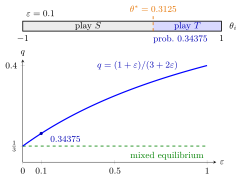
The figure uses the chicken game of the Examples. At the top, : every type plays a pure action, below the cutoff and above it, so an opponent who does not see observes with probability . Below, this probability is plotted against ; as the perturbation shrinks it falls to , the probability of in the mixed equilibrium of the unperturbed game.
The limiting probabilities are pinned down by the opponents' incentives, not by the player's own. In the perturbed game, player 's probability of an action must leave player 's cutoff type exactly indifferent; as this forces it towards the value that makes indifferent in , as in the indifference principle for mixed strategies.
The theorem is about limits of equilibria of nearby games, not about every perturbation of every game; nongeneric games can have mixed equilibria that cannot be purified.
Key Results
- Pure strategies in are type-contingent: typically a cutoff rule "choose action if and only if is above a threshold".
- The induced action distribution of player converges to as .
- Pure Nash equilibria of that are strict are also approximated by equilibria of , in which almost all types play the pure action.
- In the theorem the perturbations are private (each player observes only her own ) and independent across players; these are hypotheses, and the conclusion is not claimed without them.
Examples
The chicken game illustrates the construction. Actions are (swerve) and (go straight), with , , , . If the opponent plays with probability , yields and yields , so the symmetric mixed equilibrium has .
Perturbed game. Add to player 's payoff from , with having the uniform distribution on , independently and privately. Type prefers if and only if , i.e. . In a symmetric equilibrium . Solving,
For : and . Every type plays a pure action (the cutoff type has probability 0), and as .
Prerequisites
Related Concepts
Sources
- Game Theory · Week 5
Aliases: purification theorem, Harsanyi purification, purification of mixed equilibria Keywords: perturbed payoffs, payoff perturbations, private payoff shocks, interpretation of mixed strategies, cutoff strategy, epsilon to zero Symbols: element of, epsilon, sigma, theta
Last updated: 16 October 2026 22:28
Harsanyi Purification TheoremNash Equilibrium in Mixed StrategiesBayesian Nash EquilibriumTypeUniform DistributionChicken GameIndifference Principle for Mixed StrategiesHarsanyi TransformationMixed Strategy