Equilibrium Path
Definition
In an extensive-form game, a strategy profile , together with Nature's probabilities, determines for every node the probability that play passes through . The path of play (or outcome) of consists of the nodes and actions reached with positive probability. For a pure-strategy profile without moves of Nature in a finite game it is a single sequence of nodes from the root to one terminal node .
If is an equilibrium, its path of play is the equilibrium path. An information set is on the equilibrium path if it is reached with positive probability,
and off the equilibrium path if .
Interpretation
The path is what an observer would actually see when the equilibrium is played. A strategy says more: it also prescribes what a player would do at information sets that are never reached. That off-path part describes the threats and promises that keep the other players on the path. In the entry game, the incumbent's plan to fight after entry is never carried out when the entrant stays out, yet it is exactly what keeps the entrant out.
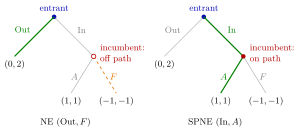
Both panels show the entry game from the Examples, with payoffs (entrant, incumbent). Under the Nash equilibrium (Out, ) on the left, the path is the single thick green branch Out; the incumbent's node (open circle) is never reached, and her planned (orange, dashed) is the off-path threat that keeps the entrant out without ever being carried out. Under the SPNE (In, ) on the right, the same node is on the path In, . The tree is identical in both panels; only the strategy profile decides which nodes are on the equilibrium path.
Being on or off the path is a property of the profile, not of the tree. The same information set is on the path under one profile and off it under another, and a subgame that is off the path is still a subgame.
Off-path behaviour does not change anyone's payoff under , so Nash equilibrium puts no optimality requirement on it. This is why Nash equilibria can rest on threats that the player would never carry out. A subgame-perfect Nash equilibrium closes this gap by requiring a Nash equilibrium in every subgame, including the subgames off the path. In games with perfect information, backward induction finds it by fixing optimal behaviour at every node, reached or not, before the path is known.
Describing an equilibrium only by its path is a common mistake: an equilibrium is a full profile, and two different equilibria can have the same path. Conversely, the question "is this profile subgame perfect?" cannot be answered from the path alone.
Key Results
- Payoffs depend only on the path: two profiles that induce the same probabilities over terminal nodes give every player the same expected payoffs, whatever they prescribe off the path.
- If a player changes her strategy only at information sets that are off the path of , the path and all payoffs stay the same. Hence the Nash conditions never restrict a player's own off-path actions; these matter only through the incentives of the other players.
- In a Nash equilibrium, every player acts optimally at each of her information sets on the equilibrium path, given the probabilities with which its nodes are reached; non-credible behaviour can occur only off the path.
- In a Nash equilibrium, the restriction to a subgame reached with positive probability is automatically a Nash equilibrium of that subgame. So a Nash equilibrium is subgame perfect if and only if its restriction to every subgame off the path is a Nash equilibrium as well.
- The whole game is a subgame that is always on the path. If a game has no proper subgame, every Nash equilibrium is subgame perfect, whatever it prescribes off the path.
Looking ahead:
- In a multistage game with observed actions (Week 4), a history is on the path if generates it with positive probability, and the one-stage deviation principle must be checked at every history, including histories off the equilibrium path.
- A weak perfect Bayesian equilibrium (Week 7) requires sequential rationality at every information set, given a system of beliefs. Bayes' rule determines the beliefs only on the equilibrium path; off the path they may be any probability distribution over the nodes.
Examples
Entry game. The entrant chooses Out, giving to (entrant, incumbent), or In; after In the incumbent chooses Accommodate or Fight .
- In the Nash equilibrium (Out, ) the path is just Out, and the incumbent's information set is off the path. Her payoff is whatever she plans, so is a best response.
- Any incumbent strategy that fights with probability supports the same path, since In then gives the entrant . These are different equilibria with one path.
- In the subgame after In, gives , so none of them is subgame perfect. The unique SPNE is (In, ), whose path is In followed by .
Sequential Battle of the Sexes. Player 1 chooses or ; player 2 observes the choice and replies, with the payoffs of the Battle of the Sexes. A strategy of player 2 lists her reply to , then her reply to .
- is the SPNE: the path is then , with payoffs , and player 2's reply to is off the path.
- is a Nash equilibrium with the same path and payoffs. It differs only off the path, where it answers with ; that gives player 2 , so it is not subgame perfect.
- is a Nash equilibrium with path then and payoffs . It rests on the off-path threat to answer with , which player 2 would not carry out ().
Grim trigger in the Prisoner's Dilemma (Week 4). With the Prisoner's Dilemma stage payoffs , , , and both players using the grim trigger strategy, the equilibrium path is in every period, and the on-path histories are . Every history containing a is off the path; there the strategies prescribe forever. Subgame perfection needs both checks: on the path, cooperation requires ; off the path, repeating the stage Nash equilibrium is optimal for every .
Off-path beliefs in a weak PBE (Week 7). Player 1 chooses Out, giving , or or . Player 2 sees only that Out was not chosen, so her two nodes form one information set, and she chooses or . Payoffs: , , and . With belief on the node after , gives player 2 and gives , so is optimal if and only if .
- Player 1 plays , player 2 plays : the information set is on the path, Bayes' rule forces , and is optimal; player 1 gets .
- Player 1 plays Out, player 2 plays : the information set is off the path, so any is allowed and makes optimal; then and give player 1 .
Both are weak PBE, and since the game has no proper subgame, both are also subgame perfect. The second is supported only by an off-path belief that puts probability at least on , although is strictly dominated by Out for player 1.
Prerequisites
Related Concepts
- Subgame-Perfect Nash Equilibrium
- Subgame
- Backward Induction
- Battle of the Sexes
- Perfect Bayesian Equilibrium
- System of Beliefs
- One-Stage Deviation Principle
- Grim Trigger Strategy
Sources
- Game Theory · Week 3 (placement provisional; not yet checked against the lecture slides)
Aliases: on the equilibrium path, off the equilibrium path, on-path, off-path, path of play Keywords: outcome of a strategy profile, reached with positive probability, unreached information set, off-path behaviour, off-path beliefs, threats and promises, non-credible threat Symbols: delta, element of, mu, sigma, sum
Last updated: 27 October 2026 11:52
Equilibrium PathExtensive-Form GameStrategy in an Extensive-Form GameInformation SetNash EquilibriumSubgame-Perfect Nash EquilibriumSubgameBackward InductionBattle of the SexesPerfect Bayesian EquilibriumSystem of BeliefsOne-Stage Deviation PrincipleGrim Trigger Strategy