Normal-Form Game
Definition
A normal-form game (strategic-form game) is a triple
where is a finite set of players, is the nonempty set of pure strategies of player , and is player 's payoff function on the set of profiles , a Cartesian product.
Payoff matrix. When and , are finite, the game is displayed as a bimatrix: player 1's strategies label the rows, player 2's strategies label the columns, and the cell in row and column contains the pair . The first number always belongs to the row player.
Interpretation
The normal form lists who plays, what each player can do and what each profile pays. It is the natural description of a static game of complete information; dynamic games, written as extensive-form games, can also be converted to normal form (Week 3), but the timing of moves is then no longer visible.
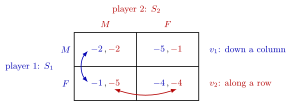
The figure labels the parts of the triple in the Prisoner's Dilemma example: the rows are , the columns are , and the cell in row and column holds (blue, first) and (red, second); for instance, row , column holds . The arrows show which numbers each player compares: player 1 fixes the column and compares first entries down it ( against in column ), while player 2 fixes the row and compares second entries along it ( against in row ).
To read a matrix correctly: player 1 compares first entries down a column (the column fixes ), and player 2 compares second entries along a row (the row fixes ). Comparing the wrong entries is a frequent error when looking for best responses.
For pure-strategy analysis (dominance, best responses, pure Nash equilibrium) only each player's ranking of profiles matters. For mixed strategies (Week 2) the payoff values themselves matter, because players then take expectations.
Key Results
- A finite two-player game with rows and columns is described by numbers; in general a finite game needs numbers.
- Applying any strictly increasing transformation to one player's payoffs leaves strict dominance between pure strategies, best responses to pure strategies and pure Nash equilibria unchanged; a positive affine transformation , , also leaves the mixed-strategy analysis unchanged.
- A two-player game is zero-sum if for every profile .
- A two-player game is symmetric if and for all .
- Strategy sets may be infinite, in which case the game is given by formulas rather than a matrix.
Examples
Prisoner's Dilemma (one common parametrization; payoffs are minus years in prison):
Here and . The game is symmetric.
Battle of the Sexes:
Matching Pennies (zero-sum; player 1 wins if the coins match):
Infinite strategy sets. In a Cournot duopoly, and as long as the price is nonnegative; there is no matrix.
Prerequisites
Related Concepts
Sources
- Game Theory · Week 1
Aliases: Payoff Matrix, strategic-form game, normal form, strategic form, bimatrix game, game in normal form, game in strategic form Keywords: bimatrix, row player, column player, (N, S_i, v_i), Prisoner's Dilemma, Battle of the Sexes, Matching Pennies, zero-sum game Symbols: alpha, beta, element of, infinity, real numbers
Last updated: 17 October 2026 21:53
Normal-Form GameBattle of the SexesBayesian GameBest ResponseChicken GameDutch AuctionExtensive-Form GameMatching PenniesMixed StrategyNash EquilibriumPareto EfficiencyPrisoner's DilemmaStage GameStrictly Dominant StrategyStrictly Dominated StrategyTypeWeakly Dominant StrategyPure StrategyStatic Game of Complete InformationFunction