Perfect Bayesian Equilibrium
Definition
A perfect Bayesian equilibrium (PBE) of an extensive-form game is an assessment , consisting of a strategy profile and a system of beliefs , such that
- Sequential rationality. At every information set , on or off the equilibrium path, the strategy of the player who moves at maximizes her expected payoff from onwards, given the beliefs over the nodes of and the other players' strategies .
- Consistency on the path. At every information set reached with positive probability under , is derived from and the prior by Bayes' rule.
- Off the path. At information sets reached with probability under , Bayes' rule imposes no restriction on beyond its being a probability distribution over the nodes. The assessment must still meet sequential rationality in condition 1.
Conditions 1–3 define what is often called weak perfect Bayesian equilibrium. Stronger versions add that off-path beliefs are also derived by Bayes' rule wherever possible (for example inside a subgame that is reached with probability ); in a signalling game the two versions coincide. The course uses the weak version.
Interpretation
PBE combines two earlier ideas. Like a Bayesian Nash equilibrium, it handles private information through beliefs about types. Like a subgame-perfect Nash equilibrium, it rules out non-credible threats, by requiring sequential rationality everywhere, not only on the path that is actually played.
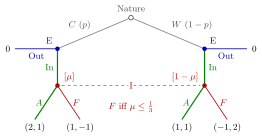
The figure draws the entry example. The entrant E knows its type; the incumbent I sees only that entry happened, so its two nodes form one information set and it needs a belief to choose. Leaves show (entrant, incumbent) payoffs, and Out gives the entrant . Comparing Fight's with Accommodate's gives the rule if and only if . The thick green path is the pooling PBE for : both types enter, Bayes' rule gives , the incumbent accommodates, and each type then prefers In to Out.
Subgame perfection alone is too weak in games with imperfect information. If Nature first draws a type that a later player does not observe, that player's information set crosses Nature's branches, so the game often has no proper subgames and then every Nash equilibrium is trivially subgame perfect. Beliefs fix this: they allow optimality to be checked at each information set, even one with several nodes.
Off-path beliefs are the source of both flexibility and multiplicity. Because Bayes' rule does not restrict them, an equilibrium can be supported by "pessimistic" beliefs that punish deviations. Different off-path beliefs can support different equilibria, and refinements such as forward induction arguments try to rule out implausible ones. A common error is to check only the on-path players: the receiver must also respond optimally at unreached information sets, given the stated beliefs there.
Key Results
- The strategy profile of every PBE is a Nash equilibrium; the converse fails.
- In games of perfect information (all information sets singletons), beliefs are trivial and PBE strategy profiles coincide with subgame-perfect equilibria found by backward induction.
- Every finite extensive-form game with perfect recall has at least one PBE, possibly in mixed or behavioural strategies.
- A weak PBE need not be subgame perfect in general, because it places no consistency requirement on beliefs in unreached subgames.
- In a signalling game with two types and pure strategies, every PBE is either separating or pooling.
Examples
Nash but not PBE. An entrant chooses Out (payoffs to the entrant, to the incumbent) or In; after In the incumbent chooses Accommodate or Fight . The profile (Out, Fight) is a Nash equilibrium: given Fight, the entrant prefers Out ( rather than ), and given Out the incumbent's action does not affect its own payoff. It is not a PBE: at the incumbent's (singleton) information set the belief is , and Fight gives . The unique PBE is (In, Accommodate).
Entry with an unknown type. Nature makes the entrant competitive () with probability or weak (). Payoffs (entrant, incumbent) after entry are: : Accommodate , Fight ; : Accommodate , Fight ; Out gives the entrant . With belief , Fight gives the incumbent and Accommodate gives , so Fight is optimal if and only if . Type always enters, since In gives at least .
- : both types enter, , the incumbent accommodates, and both types earn more than . This is a pooling PBE.
- : no pure-strategy PBE exists. If both types enter, and the incumbent fights, so prefers Out. If only enters, and the incumbent accommodates, so prefers In. The PBE has entering with probability (giving ), and the incumbent accommodating with probability , which makes indifferent: .
Prerequisites
- System of Beliefs
- Bayes Rule for Beliefs
- Sequential Rationality
- Subgame-Perfect Nash Equilibrium
- Bayesian Nash Equilibrium
Related Concepts
Sources
- Game Theory · Week 7
Aliases: PBE, weak perfect Bayesian equilibrium, perfect Bayesian Nash equilibrium, PBNE Keywords: assessment (sigma, mu), sequential rationality given beliefs, on-path and off-path beliefs, weak PBE, entry game with incomplete information Symbols: mu, sigma
Last updated: 27 October 2026 11:52
Perfect Bayesian EquilibriumPooling EquilibriumSeparating EquilibriumSignalling GameSystem of BeliefsBayes Rule for BeliefsSequential RationalitySubgame-Perfect Nash EquilibriumBayesian Nash EquilibriumForward InductionEquilibrium Path