Iterated Elimination of Strictly Dominated Strategies
Method
Let be a normal-form game and set for every player.
- Round . In the reduced game with strategy sets , find for each player every strategy in that is a strictly dominated strategy relative to another strategy in , where the comparison runs only over the remaining opponent profiles .
- Delete these strategies, giving .
- Repeat until no player has a strictly dominated strategy in the reduced game.
The profiles that remain form the IESDS outcome. If exactly one profile remains, the game is dominance solvable and that profile is the IESDS prediction.
Interpretation
Round 1 removes what no rational player would play. Later rounds use reasoning about others: once player 1 knows player 2 will not use a deleted strategy, some strategy of player 1 may become dominated in the smaller game even though it was not dominated in the original game. Round needs rationality plus levels of "everyone knows that ..." about rationality, so common knowledge of rationality justifies running the procedure to the end.
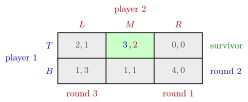
The figure shows Example 1 after the procedure has finished. Each grey strategy carries the round in which it was deleted: first (dominated by for player 2), then (dominated by only once is gone), then . The order of the labels is the chain of reasoning: deleting needs player 1 to know that player 2 is rational, and deleting needs player 2 to know that too. The surviving cell with payoffs is the IESDS prediction.
The procedure checks dominance in the current reduced game; checking against the original game misses later deletions. It also never uses beliefs, so when nothing is dominated it makes no prediction at all.
Key Results
- In a finite game the IESDS outcome does not depend on the order of deletion or on how many dominated strategies are removed in each round.
- Every Nash equilibrium survives IESDS.
- In a finite game, if IESDS leaves a single profile, that profile is the unique Nash equilibrium.
- If every player has a strictly dominant strategy, one round leaves exactly the strictly dominant strategy equilibrium.
- IESDS can delete nothing: in Battle of the Sexes and Matching Pennies no strategy is strictly dominated.
- For weak dominance (see weakly dominant strategy) the result can depend on the order of deletion, which is one reason the procedure is stated with strict dominance.
Examples
1. Three rounds. Player 1 chooses rows, player 2 columns; payoffs .
- Round 1: player 1 has no dominated strategy ( is better against , against and ). For player 2, is strictly dominated by ( against , against ). Delete .
- Round 2: without , strictly dominates ( against , against ). Delete .
- Round 3: given , gives player 2 a payoff of , so is deleted.
The outcome is with payoffs . Note that was not dominated in the original game ( against ); its deletion relies on knowing that player 2 is rational.
2. No prediction. In Battle of the Sexes (, , mismatches ) each strategy is the unique best choice against one of the opponent's strategies, so nothing is deleted and all four profiles survive.
Prerequisites
Related Concepts
- Nash Equilibrium
- Strictly Dominant Strategy
- Weakly Dominant Strategy
- Best Response
- Prisoner's Dilemma
Sources
- Game Theory · Week 1
Aliases: IESDS, iterated strict dominance, iterated deletion of strictly dominated strategies, iterative elimination of strictly dominated strategies, successive elimination of strictly dominated strategies Keywords: surviving strategies, dominance solvable, iterated-elimination equilibrium, order of elimination, common knowledge of rationality, Battle of the Sexes Symbols: element of, subset
Last updated: 17 October 2026 21:53
Iterated Elimination of Strictly Dominated StrategiesStrictly Dominated StrategyCommon KnowledgeNash EquilibriumStrictly Dominant StrategyWeakly Dominant StrategyBest ResponsePrisoner's Dilemma