Nash Existence Theorem
Theorem
Let be a normal-form game with a finite set of players and a finite pure-strategy set for every player. Then has at least one Nash equilibrium in mixed strategies: there is a profile with for every .
Interpretation
The theorem (Nash, 1950–1951) guarantees that the Nash equilibrium concept never makes an empty prediction in a finite game, provided mixed strategies are allowed. It says nothing about how many equilibria there are, which one is played, or whether any equilibrium is in pure strategies.
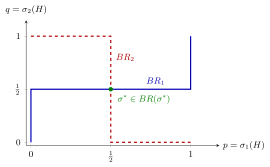
The figure draws the two best-response correspondences of Matching Pennies, with player 1 winning on a match, across and up. No corner, that is no pure profile, lies on both graphs, so there is no pure equilibrium. Each graph jumps across the square, though, and at the jump it takes a whole segment of best responses, so the two graphs meet at : this mixed profile is the equilibrium that the theorem guarantees.
Beyond the course
Textbooks prove the theorem with a fixed-point theorem (Kakutani's or Brouwer's) applied to the players' best responses. The course uses the statement and its consequences; the proof is not part of the course.
Finiteness is a sufficient condition, not a necessary one. Many games with infinite strategy sets, such as the Cournot duopoly, have equilibria, but some do not (see the last example).
Key Results
- Existence holds for every finite game; uniqueness does not (coordination games have several equilibria).
- Existence of a pure-strategy equilibrium is not guaranteed: Matching Pennies has none.
- Both finiteness assumptions (players and strategies) appear in the statement; dropping finiteness of without further conditions can destroy existence.
- The result extends to existence of subgame-perfect equilibria in finite extensive-form games with perfect recall and of Bayesian Nash equilibria in finite Bayesian games, in mixed strategies.
Examples
Matching Pennies. No cell is a pure equilibrium, since the loser of each cell wants to switch. By the theorem a mixed equilibrium exists; the indifference principle gives the unique one, .
Pure coordination. Payoffs are at , at and otherwise. Both and are pure equilibria. With , player 1 is indifferent when , so ; by symmetry . The game has three equilibria, the mixed one giving each player .
An infinite game without equilibrium. One player chooses and receives . For any , the choice is better, and any mixed strategy has expected payoff below and can also be improved. No best response exists, so there is no Nash equilibrium. The strategy set is infinite and not compact, so the theorem does not apply.
Prerequisites
Related Concepts
- Indifference Principle for Mixed Strategies
- Cournot Duopoly
- Subgame-Perfect Nash Equilibrium
- Bayesian Nash Equilibrium
- Matching Pennies
Sources
- Game Theory · Week 2
Aliases: Nash's theorem, existence of Nash equilibrium, Nash equilibrium existence theorem, Nash's existence theorem Keywords: finite game, Kakutani fixed-point theorem, Brouwer fixed-point theorem, existence in mixed strategies, Matching Pennies Symbols: delta, element of, sigma
Last updated: 17 October 2026 21:53
Nash Existence TheoremNash Equilibrium in Mixed StrategiesMixed StrategyBest-Response CorrespondenceIndifference Principle for Mixed StrategiesCournot DuopolySubgame-Perfect Nash EquilibriumBayesian Nash EquilibriumMatching Pennies