Trigger Strategy
Definition
In a repeated game, a trigger strategy for player prescribes a target action (the cooperative phase) as long as the history shows no deviation from the target profile since the cooperative phase began, and switches to a punishment phase once a deviation has occurred. In the punishment phase the players follow a specified punishment path, typically a stage-game Nash equilibrium played either forever (the grim trigger strategy) or for periods, after which play returns to .
Interpretation
A trigger strategy turns the future into a hostage: a player who grabs a one-period gain loses the difference between cooperative and punishment payoffs in later periods. Deviation is unprofitable when the discounted future loss exceeds the immediate gain, which requires enough patience and a punishment that is severe or long enough.
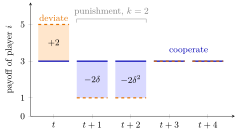
In the figure, and the payoffs are those of the example below. Deviating at raises the payoff from to , a gain of , but the two punishment periods pay instead of , losses worth and in period- terms. The deviation is unprofitable when , which is the condition of the example.
Two separate conditions must hold for a subgame-perfect equilibrium. On the cooperative path, nobody should gain by deviating. In the punishment phase, carrying out the punishment must itself be optimal; a threat to play something that is not a best response once the trigger has been pulled is not credible. An absorbing stage-game Nash punishment takes care of the second condition. For finite punishment the continuation rule also matters. In the example below, every deviation restarts all punishment periods; a stage Nash punishment with payoffs no higher than the target then makes punishment-phase deviations unprofitable.
A trigger strategy reacts to deviations, not to bad luck: it relies on actions being observed. When punishment payoffs are below the target, shorter punishments reduce the future loss and can require a higher ; a sufficiently short punishment may fail for every .
Key Results
- With a finite punishment that restarts after any deviation, a stage-game Nash punishment and for every player are sufficient to rule out punishment-phase deviations. Being a stage Nash equilibrium is not necessary when a deviation also worsens the continuation payoff.
- With -period punishment by , a one-period deviation from is unprofitable if and only if for every .
- When , the left side is nondecreasing in and ; letting gives the grim trigger condition.
- With a finite horizon and a unique stage equilibrium, no subgame-perfect equilibrium, in trigger strategies or otherwise, plays anything but that equilibrium.
Examples
Short versus long punishment. Prisoner's Dilemma with , , : the gain from defecting is and the per-period loss during punishment is . The condition becomes
- : , impossible for ; one period of punishment never deters.
- : , i.e. .
- (grim trigger): , i.e. .
A deviation during punishment yields instead of and restarts the punishment, so it never pays. For the symmetric two-action model in the interactive figure, write , and , with . When punishment periods remain, obeying gives , whereas deviating once gives . The smallest compliance margin occurs at , so all punishment states are optimal exactly when . This check is separate from the cooperative-path inequality; for an absorbing grim punishment it reduces to .
Collusion. Firms in a repeated Cournot duopoly can produce the joint-monopoly quantities and revert to Cournot quantities after any deviation; the grim version is worked out on the grim trigger page.
Prerequisites
Related Concepts
Sources
- Game Theory · Week 4
Aliases: trigger strategies, punishment strategy Keywords: punishment phase, cooperative phase, finite punishment, k-period punishment, forgiving trigger, tacit collusion, Prisoner's Dilemma Symbols: delta, infinity, square root
Last updated: 27 October 2026 11:52
Trigger StrategyGrim Trigger StrategyRepeated GameHistory in a Multistage GameNash EquilibriumOne-Stage Deviation PrincipleFolk TheoremCournot Duopoly