English Auction
Definition
In an English auction the price starts low and rises continuously (for example on a clock). Each bidder is either active or has dropped out, and dropping out is irreversible. The auction ends when only one bidder remains; that bidder wins and pays the price at which the last rival dropped out. A strategy specifies, for each valuation and each history of observed drop-outs, the price at which the bidder quits.
Interpretation
With private values, a bidder with valuation should stay active while the price is below (winning at that price would be profitable) and quit once the price reaches (winning at a higher price would be a loss). This rule is a weakly dominant strategy, by the same case argument as in the second-price auction: the bidder's quitting point only decides whether she wins, while the price is set by the strongest rival.
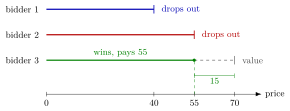
The figure uses the three bidders of the Examples. Each bar shows how long a bidder stays active as the price rises; under the dominant strategy each bar ends at the bidder's value. Bidder 1 quits at and bidder 2 at , which ends the auction: bidder 3 wins at the price , the second-highest value, and keeps the gap up to her own value.
Under these strategies the highest-value bidder wins and pays the second-highest valuation, exactly the outcome of truthful bidding in the second-price sealed-bid auction. This is the sense in which the two formats are equivalent with private values.
The equivalence is weaker than for the Dutch auction and the first-price auction. In an English auction bidders observe when others drop out. With private values this information is irrelevant, because it does not change one's own value. With interdependent or common values and three or more bidders, the drop-out prices reveal information about the object's worth, so the English and second-price auctions can then differ.
Key Results
- With private values, "stay in until the price reaches " is weakly dominant, whatever the distribution of values and the number of bidders.
- In that equilibrium the winner is the bidder with the highest value and the price equals the second-highest value (up to the bid increment in a discrete-step auction).
- With private values the outcome coincides with the truthful equilibrium of the second-price auction; hence expected revenue is , equal to for i.i.d. values.
- Under the conditions of the revenue equivalence theorem, the English auction yields the same expected revenue as the first-price, second-price and Dutch auctions.
Examples
Three bidders. Valuations are , and . Bidding by value, bidder 1 drops out at price and bidder 2 at . Bidder 3 wins at price and earns . In a second-price sealed-bid auction with truthful bids , bidder 3 also wins and pays .
Why not stay longer? If bidder 2 (value ) stayed in until , she would still lose to bidder 3 and gain nothing. If bidder 3's value were instead, bidder 2 staying until would make her win at and earn . Staying past one's value never helps and sometimes hurts.
Prerequisites
Related Concepts
Sources
- Game Theory · Week 6
Aliases: ascending auction, ascending-price auction, open ascending-bid auction, open ascending auction Keywords: ascending clock, drop-out price, button auction, stay in until the price reaches your value Symbols: theta
Last updated: 17 October 2026 21:53
English AuctionPrivate-Value AuctionSecond-Price AuctionWeakly Dominant StrategyDutch AuctionFirst-Price AuctionRevenue Equivalence TheoremCommon-Value Auction