Pure Strategy
Definition
A pure strategy of player is a deterministic plan of action: it specifies, without any randomization, which action the player takes in every situation in which he or she may have to move. The set of all pure strategies of player is denoted .
A pure-strategy profile is a list with for every player ; the set of all profiles is the Cartesian product . For player ,
collects the strategies of all other players, and . Writing means that player switches to while everyone else keeps their strategy.
Interpretation
A strategy is a complete description of how a player will play, detailed enough that someone else could carry it out on the player's behalf. In a static game of complete information nobody observes anything before choosing, so a pure strategy is just one action.
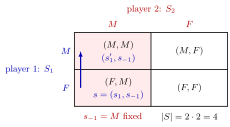
The figure lays out for the Prisoner's Dilemma of the Examples: each cell is one profile, in all. In we have and . A switch by player 1 alone to moves within the shaded column, because is held fixed, and lands on ; this is the comparison behind dominance, best responses and Nash equilibrium.
The notation is used throughout game theory: strict dominance, best responses and Nash equilibrium all compare with while holding fixed.
"Pure" contrasts with mixed: a mixed strategy (Week 2) is a probability distribution over pure strategies, and a pure strategy is the special case that puts probability on one element of .
Key Results
- With finite strategy sets, the number of pure-strategy profiles is , and .
- Strategy sets need not be finite: a firm in a Cournot duopoly chooses , an interval.
- In a static game, strategies and actions coincide.
- In a dynamic game (Week 3) a pure strategy is a complete contingent plan with one action at each of the player's information sets, so the number of pure strategies is the product of the numbers of actions over those information sets; see strategy in an extensive-form game.
Examples
Prisoner's Dilemma. (Mum, Fink), so has profiles. In the profile , and .
Three players. If , and , there are profiles, and player 1 faces possible combinations of the others' strategies.
Contingent plan. Player 1 chooses or ; player 2 observes this and then chooses or . Player 2 has two actions at each of two decision points, hence pure strategies: , , , , where means " after , after ". Two actions per node do not mean two strategies.
Prerequisites
Related Concepts
Sources
- Game Theory · Week 1
Aliases: deterministic strategy Keywords: strategy set S_i, strategy profile, pure-strategy profile, s_{-i}, complete contingent plan, Prisoner's Dilemma Symbols: element of, infinity, product
Last updated: 22 October 2026 19:04
Pure StrategyInformation SetMixed StrategyNormal-Form GamePareto EfficiencyStrategy in an Extensive-Form GameStatic Game of Complete InformationCartesian ProductBest Response