One-Stage Deviation Principle
Proposition
Consider a multistage game with observed actions that is either finite, or infinite with payoffs , , and bounded stage payoffs. A strategy profile is a subgame-perfect Nash equilibrium if and only if there is no player , stage and history such that player strictly gains, in the subgame starting at , from a strategy that
- differs from only in the action chosen at , and
- agrees with at every later history,
while the other players follow .
Interpretation
A strategy can be changed in infinitely many ways, at many histories at once. The principle says it is enough to test the simplest deviations: change today's action once, then return to the strategy. The deviator still evaluates the full continuation, so tomorrow's punishment enters the comparison; "one-stage" refers to where the action changes, not to ignoring the future.
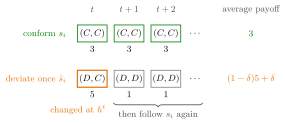
The figure draws the one-stage test from the grim-trigger example at a history with no deviation yet. The deviator changes only the action at (orange box) and then follows her strategy again, which after a deviation prescribes forever; the opponent does the same, so the continuation is with payoff . The comparison is between the whole rows, against , not between the stage- payoffs and alone; the deviation does not pay if and only if .
The proof idea: if some deviation is profitable, a finite one is (in a finite game trivially; in an infinite game because discounting with bounded payoffs makes far-future changes negligible). Take a profitable finite deviation with the fewest changes and look at the last history where it changes behaviour: if that change alone were not profitable, it could be undone without loss, giving a profitable deviation with fewer changes. So the last change is a profitable one-stage deviation. This is the same logic as the principle of optimality in dynamic programming.
The hypotheses matter. Observed actions make each history a subgame. Discounting (more generally, continuity at infinity) rules out deviations whose gain only appears "at infinity"; without it, a strategy can pass every one-stage test yet fail to be optimal.
Key Results
- The check must be made at every history, including histories off the equilibrium path.
- In a finite game the principle is equivalent to checking optimality by backward induction stage by stage.
- For grim trigger strategies punishing with a stage-game Nash equilibrium, only the cooperative-phase test can fail.
- Necessity is immediate (a one-stage deviation is a deviation); the content of the result is sufficiency.
Examples
Grim trigger in the Prisoner's Dilemma. Stage payoffs , , , ; both players use the grim trigger strategy. Two kinds of history:
- No deviation yet. Conforming gives average payoff 3. Playing once and then following the strategy (which now prescribes forever) gives . No gain if and only if .
- A deviation has occurred. Conforming gives 1. Playing once gives . Never profitable.
So the profile is subgame perfect if and only if .
A profile that fails. "Always play , whatever happened" fails the test at every history: at any history, playing once gives for every . It is not subgame perfect, and not even a Nash equilibrium.
Prerequisites
Related Concepts
Sources
- Game Theory · Week 4
Aliases: one-shot deviation principle, one-step deviation principle, OSDP, one-deviation property, single-deviation principle Keywords: single deviation, unimprovability, continuity at infinity, checking subgame perfection, profitable deviation, Prisoner's Dilemma Symbols: delta, element of, sum
Last updated: 17 October 2026 21:53
One-Stage Deviation PrincipleMultistage GameHistory in a Multistage GameSubgame-Perfect Nash EquilibriumGrim Trigger StrategyTrigger StrategyFolk TheoremBackward InductionEquilibrium Path