Repeated Game
Definition
Let be a stage game. The repeated game is the multistage game in which is played in every period ( periods; time starts at ), each player observes all past action profiles, and a strategy may condition on the history .
- Finitely repeated (): player 's payoff is with .
- Infinitely repeated (, periods ): with discount factor , player 's payoff is whenever this discounted sum converges. Bounded stage payoffs, in particular a finite stage game, ensure absolute convergence for every action stream. With unbounded stage payoffs, alone does not ensure convergence, so the admissible payoff streams need an additional summability condition. When convenient it is normalized to the average discounted payoff
The factor only rescales; it does not change any player's preferences over streams, so it is used only where it makes payoffs easier to compare.
Interpretation
Repetition lets today's behaviour be rewarded or punished tomorrow. Whether this matters depends on the horizon. With a known last period, nothing that happens later can influence play in that period, so it must be a stage-game Nash equilibrium; if that equilibrium is unique, the argument unravels backwards to the first period. With an infinite horizon there is no last period, and cooperation can be enforced by threats such as the grim trigger strategy.
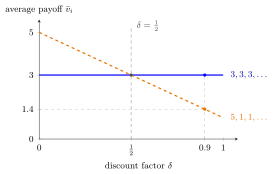
The figure plots the two streams of the Examples on the average-payoff scale. Mutual cooperation gives for every , while the stream (defect once, then forever) gives , which falls as the future weighs more. The lines cross at : to the right of this threshold the one-period gain of no longer pays for the loss of in every later period, which is the condition for the grim trigger strategy to sustain cooperation.
The discount factor measures patience. It can also be read as the probability that the relationship continues for another period, so "infinite" means "no known end date", not "literally forever". Large makes future losses weigh heavily against a one-period gain.
The normalization by puts repeated-game payoffs on the scale of stage payoffs: by the geometric series , a constant stream has average .
Key Results
- If has a unique Nash equilibrium and , the unique subgame-perfect Nash equilibrium plays in every period after every history.
- For any and , repeating a fixed stage-game Nash equilibrium regardless of history is subgame perfect.
- In the infinitely repeated Prisoner's Dilemma of the Examples, mutual cooperation is the outcome of a subgame-perfect equilibrium in grim trigger strategies if and only if : the one-period gain from defecting against a cooperator, divided by the difference between that defection payoff and the payoff of mutual defection.
- The folk theorem: for close to 1, every feasible payoff vector giving each player strictly more than the payoff of a Nash equilibrium of the stage game is the average payoff of a subgame-perfect equilibrium.
Examples
Finite repetition. Take the Prisoner's Dilemma with , , , , played 10 times (). In the last period, , every subgame is a one-shot game, so both play . Given that, play at cannot affect the future and both play again, and so on back to : the unique subgame-perfect outcome is ten times, an undiscounted total payoff of 10 each.
Average payoffs. With , the stream has average 3. The stream has average . Cooperation (3) beats this one-time defection (1.4); the two are equal at .
Prerequisites
Related Concepts
- Trigger Strategy
- Grim Trigger Strategy
- Folk Theorem
- One-Stage Deviation Principle
- Prisoner's Dilemma
Sources
- Game Theory · Week 4
Aliases: supergame, repeated interaction, iterated game Keywords: finitely repeated game, infinitely repeated game, G(T, delta), average discounted payoff, discount factor delta, repeated Prisoner's Dilemma Symbols: delta, element of, infinity, sum
Last updated: 27 October 2026 11:52
Repeated GameFolk TheoremGrim Trigger StrategyTrigger StrategyStage GameMultistage GameHistory in a Multistage GameSubgame-Perfect Nash EquilibriumOne-Stage Deviation PrinciplePrisoner's Dilemma