Mixed Strategy
Definition
Let player in a normal-form game have a finite set of pure strategies . A mixed strategy for player is a probability distribution on : a function with
The set of all mixed strategies of player is written . The support of is the set of pure strategies with . A pure strategy is the degenerate mixed strategy that puts probability on . When is an interval (for example, prices or bids), a mixed strategy is given by a cumulative distribution function on .
A mixed-strategy profile assumes that players randomize independently. Player 's payoff is the expectation
where .
Interpretation
A mixed strategy can be read literally, as a player who uses a randomizing device, or as a description of the opponents' uncertainty about what player will do. Either reading leads to the same calculations; it relies on players being expected payoff maximizers, so that only expected payoffs matter.
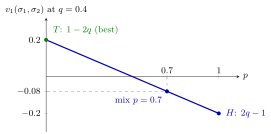
The figure fixes player 2's mixture at in the Matching Pennies example and plots player 1's expected payoff against her probability of . Because is a weighted average of the two pure-strategy payoffs, the graph is a straight line between at and at . The mixture earns , in between; the maximum is reached at a pure strategy, here .
Move : player 1's expected payoff runs along a straight line between her two pure-strategy payoffs, so no mixture beats the better pure strategy. Set and the line becomes flat.
Mixing never lets a player beat her own best pure strategy against fixed opponents. Because the expected payoff is a weighted average of the payoffs of the pure strategies in the support, it is at most the largest of them. Randomization matters for a different reason: it changes what the opponents face, which is why games such as Matching Pennies have an equilibrium only in mixed strategies.
The independence assumption matters: a mixed-strategy profile cannot describe correlated play such as "both players follow the same coin toss".
Key Results
- With pure strategies, is the simplex , a compact convex set; for it contains infinitely many mixed strategies.
- By linearity of expectation, , which is linear in .
- Hence , and is a best response if and only if every pure strategy in its support is a best response.
- A pure strategy can be strictly dominated by a mixed strategy even when no pure strategy dominates it.
Examples
Matching Pennies. Player 1 wins if the coins match and loses otherwise. Let player 1 play with probability and player 2 play with probability . Then , , and
For , : the coins match with probability , so .
Dominance by a mixture. Player 1 has payoffs , , against player 2's and . Neither nor dominates , but yields , strictly more than against both columns.
Prerequisites
Related Concepts
- Nash Equilibrium in Mixed Strategies
- Indifference Principle for Mixed Strategies
- Strictly Dominated Strategy
- Harsanyi Purification Theorem
- Matching Pennies
Sources
- Game Theory · Week 2
Aliases: randomized strategy, mixed strategies, randomised strategy Keywords: σ_i, ΔS_i, randomization, support of a mixed strategy, mixed-strategy profile, Matching Pennies Symbols: delta, element of, product, real numbers, sigma, sum
Last updated: 22 October 2026 19:04
Mixed StrategyBayes Rule for BeliefsFolk TheoremIndifference Principle for Mixed StrategiesMatching PenniesNash Equilibrium in Mixed StrategiesNash Existence TheoremStage GamePure StrategyNormal-Form GameExpected Payoff MaximizationDistributionStrictly Dominated StrategyHarsanyi Purification Theorem