Signalling Game
Definition
A signalling game is a two-player dynamic Bayesian game with the following timing:
- Nature draws the sender's type according to a common prior .
- The sender observes and chooses a message (signal) .
- The receiver observes but not , and chooses an action .
Payoffs are and . A sender strategy is a type-contingent message ; a receiver strategy is a response to each message; the receiver's beliefs are posteriors , one distribution for each message.
Interpretation
As an extensive-form game, the receiver has one information set per message, and each contains one node per type. The natural solution concept is therefore perfect Bayesian equilibrium: the receiver needs beliefs after every message, including messages that no type sends.
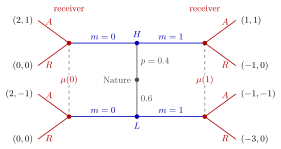
The figure draws the example below in the usual signalling layout. Nature moves in the centre, the sender knows her type and sends (left) or (right), and the receiver observes only : her two nodes after the same form one information set, at which she holds the belief and chooses or . The payoffs at the ends, sender first, show why the message can separate the types: it costs only for but for .
Different message distributions across types of positive prior probability make the message informative. In a separating equilibrium, each type must weakly prefer its own message to every alternative message, given the receiver's responses; strict preference is not required. In the example below, is less costly for type , which makes these incentives strict. Equal or zero signalling costs do not by themselves preclude separation: different preferences over the receiver's action can also deter imitation, and indifferent types can choose different messages.
Equilibria are classified by how much the message reveals: in a separating equilibrium each type sends a different message and the receiver learns the type; in a pooling equilibrium all types send the same message and the receiver learns nothing beyond the prior. Other applications include an entrant whose entry decision signals whether it is competitive or weak, and a research institute sending a message to influence a politician's policy choice.
Key Results
- A sender strategy maps types to messages; a receiver strategy maps messages (not types) to actions.
- On-path beliefs follow from the sender's strategy by Bayes' rule; beliefs after unsent messages are free in a PBE and determine which deviations are deterred.
- A signalling game typically has several PBEs, both separating and pooling, supported by different off-path beliefs.
- With at least two types of positive probability, a signalling game has no proper subgames, because each receiver information set spans several types; subgame perfection alone therefore has no bite.
Examples
A two-type signalling game. The sender is type with prior probability or type with probability . She sends , which is free, or , which costs to type and to type . The receiver sees and accepts () or rejects (). Accepting gives the receiver if the type is and if it is ; rejecting gives her . The sender gets if accepted and if rejected, minus her cost of . With belief , accepting is worth to the receiver, so she accepts if and rejects if .
- Separating ( sends , sends ): and , so the receiver accepts after and rejects after . gets ; gets . Neither deviates: a PBE.
- Pooling on : , so the receiver rejects and both types get . With off-path belief she also rejects after , so deviating gives only and only : a PBE.
- Pooling on : , so the receiver rejects, and gets , less than the or more she gets from under any belief: not a PBE.
Prerequisites
Related Concepts
Sources
- Game Theory · Week 7
Aliases: Signaling Game, sender-receiver game Keywords: sender and receiver, message, costly signal Symbols: element of, mu, theta
Last updated: 27 October 2026 11:52
Signalling GamePooling EquilibriumSeparating EquilibriumBayesian GameTypeExtensive-Form GamePerfect Bayesian EquilibriumAdverse SelectionMarket for Lemons