Adverse Selection
Definition
Adverse selection arises when one side of a transaction has private information, a type such as quality or risk, that affects the other side's value of trading, and the terms of trade cannot depend on that type. Because the uninformed side can only condition on the conditional expectation of the type among those willing to trade, a given price or contract can be accepted disproportionately by the types that are worse for the uninformed side. As a result, some mutually beneficial trades may fail to take place; whether trade is lost depends on the distribution of types and the terms offered.
Interpretation
The word "adverse" refers to the selection, not to the people: those who accept a given offer are, on average, the ones the offer-maker would least like to trade with. In the market for lemons, a seller of a good car does not want to sell at an average price; a low-risk customer does not want to pay an average premium. When they withdraw, the average type among those who remain gets worse, which lowers the acceptable price further.
Adverse selection concerns hidden information that exists before the contract (who you are). It differs from moral hazard, which concerns hidden actions taken after the contract (what you do).
Game-theoretically, the uninformed party's offer and the informed party's type-contingent acceptance rule are equilibrium strategies of a game with incomplete information, for example a Bayesian Nash equilibrium. When positive-surplus trades are excluded, the inefficiency can arise in equilibrium even though everyone acts rationally. Remedies change the information structure: inspections, warranties, screening by menus of contracts, or signals sent by the informed side, as in a signalling game.
Key Results
- At a price that every type accepts, the uninformed side's value is the unconditional mean; at a price only low types accept, it is the mean conditional on low quality.
- Trade with high types survives only if their share is large enough; below a threshold, only the worst types trade.
- With a continuum of types the process can unravel completely, so that no trade occurs at any positive price.
- The outcome is generally not Pareto efficient: high-quality trades with positive gains are lost.
Examples
Used cars, buyer makes the offer. A seller's car is high quality () with probability and low () with probability . Values in thousands of euros:
| seller | buyer | |
|---|---|---|
| 4 | 6 | |
| 10 | 12 |
The buyer makes a take-it-or-leave-it offer ; each seller type accepts if and only if is at least her own value.
- (both accept): buyer's expected value , payoff .
- (only accepts): payoff .
- Any is accepted only by and pays less than ; any pays 0.
The buyer offers 4 and only lemons trade, although each high-quality car is worth 2 more to the buyer than to the seller. Pooling at 10 would be optimal if and only if , i.e. , where is the share of high quality.
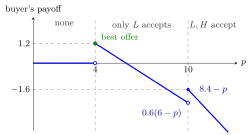
The figure plots the buyer's expected payoff against the offer , with the seller values 4 and 10 marked as dashed thresholds. Raising above 4 only pays more to the same low-quality sellers, so the payoff falls along ; at the high types join, but the pooled value is below the price, so the payoff jumps only to . The best offer is , where only lemons trade.
Move the offer : the payoff peaks at , where only lemons sell. Raise the share of high-quality cars past and offering becomes best.
Insurance. Equal numbers of low-risk (loss 100 with probability ) and high-risk (probability ) customers are willing to pay 15 and 55. The break-even pooled premium is , so low risks drop out and the premium must rise to at least 50: only high risks are insured.
Prerequisites
Related Concepts
Sources
- Game Theory · Week 5
Aliases: hidden information problem, anti-selection, antiselection Keywords: asymmetric information, private information about quality, lemons problem, pooling price, unravelling, insurance with high and low risks Symbols: element of, mu
Last updated: 27 October 2026 11:52
Adverse SelectionMarket for LemonsTypeBayesian Nash EquilibriumConditional Expectation Given an EventSignalling GameWinner's CursePareto Efficiency