Battle of the Sexes
Definition
The Battle of the Sexes is a two-player normal-form game in which each player chooses or (traditionally opera or football). Both players want to choose the same option, but player 1 prefers that they meet at and player 2 that they meet at ; failing to coordinate gives both the lowest payoff. The standard numerical version:
Interpretation
Battle of the Sexes is a coordination game with a conflict of interest. Matching is good for both, but the two ways of matching split the gains differently. It models situations such as two firms choosing a common technical standard, each preferring its own.
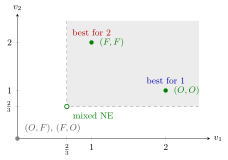
Each point is a payoff pair from the table. The two pure equilibria (filled green) are both far better than miscoordination at , but player 1 prefers with and player 2 prefers with , so neither point is better for both. The mixed equilibrium of Week 2 (open circle, see Key Results) gives each player ; both pure equilibria lie in the shaded quadrant of pairs that are higher for both players, which is the sense in which the mixed equilibrium is Pareto dominated by each of them.
The game has more than one Nash equilibrium, and the theory alone does not say which one is played. Each pure equilibrium is self-enforcing once both players expect it, but nothing in the payoffs tells the players which of the two to expect. Common knowledge of rationality does not help either: no strategy is strictly dominated, so dominance reasoning eliminates nothing. In practice coordination may come from convention, communication or the order of moves.
Each player's best response is to do what the other does, so the right choice depends entirely on the belief about the other player. This is the opposite of the Prisoner's Dilemma, where finking is best whatever the other does. Unlike in the Prisoner's Dilemma, both pure equilibria here are efficient: the players disagree about which coordinated outcome to choose. The mixed equilibrium is Pareto dominated, as the figure shows.
Read the blue graph as player 1's best reply to the probability that player 2 goes to : she chooses when and when , as in the example below. The red graph does the same for player 2, with threshold . Where the graphs meet, both players best respond: at the pure equilibria and , and at the mixed equilibrium of Week 2. Change (player 1's payoff at , player 2's at ) and (the other way round): the thresholds move, but both pure equilibria remain.
Compare it with two other games. In Matching Pennies (Week 2) one player wants to match and the other to mismatch, so there is no pure equilibrium at all. In the chicken game both have two pure equilibria and one mixed equilibrium, but in chicken each player wants to do the opposite of the other, while here each wants to do the same.
Key Results
- The pure Nash equilibria are and ; the two mismatches are not equilibria.
- The best responses are , , and .
- No player has a dominant strategy and no strategy is strictly dominated, so iterated elimination of strictly dominated strategies removes nothing.
- Both pure equilibria are Pareto efficient and cannot be ranked against each other: player 1 prefers and player 2 prefers . Both give the same total payoff, .
- In a pure coordination game, where both players prefer the same matched outcome, one equilibrium would Pareto dominate the other; in Battle of the Sexes neither does.
Looking ahead:
- With mixed strategies (Week 2) there is exactly one further Nash equilibrium in mixed strategies: player 1 plays with probability and player 2 plays with probability , giving each an expected payoff of . It is Pareto dominated by both pure equilibria.
- If player 1 moves first and player 2 observes the move (Week 3), the unique subgame-perfect Nash equilibrium leads to : the first mover gets her preferred outcome.
Examples
Pure equilibria. Check best responses cell by cell. Against , player 1 prefers (); against , she prefers (). Player 2 likewise wants to match player 1 ( against , against ). The cells where both players are best responding are and . At either player gains by switching, so it is not an equilibrium.
A belief decides the choice. If player 1 believes that player 2 goes to with probability , her expected payoffs are from and from . She prefers exactly when , that is, . Even a fairly small chance that player 2 comes to the opera is enough, because player 1 gains more from meeting there.
The mixed equilibrium (Week 2). Let be player 1's probability of and player 2's. By the indifference principle, each player's mixture makes the other indifferent:
Each player expects , less than the worse of her two pure-equilibrium payoffs. The players miscoordinate with probability .
Sequential version (Week 3). Suppose player 1 chooses first and player 2 observes the choice. Player 2's strategies are pairs (reply to , reply to ). By backward induction she replies to () and to (), the strategy . Anticipating this, player 1 compares from with from and chooses . The SPNE is with outcome and payoffs . The profile is still a Nash equilibrium with outcome , but it rests on player 2's non-credible threat to choose after .
Prerequisites
Related Concepts
- Pareto Efficiency
- Prisoner's Dilemma
- Matching Pennies
- Nash Equilibrium in Mixed Strategies
- Indifference Principle for Mixed Strategies
- Subgame-Perfect Nash Equilibrium
- Chicken Game
Sources
- Game Theory · Week 1 (placement provisional; not yet checked against the lecture slides)
Aliases: BoS, Bach or Stravinsky, battle of sexes Keywords: sequential Battle of the Sexes, coordination game, conflicting preferences over equilibria, opera or football, two pure equilibria and one mixed equilibrium, multiple equilibria, first-mover advantage
Last updated: 27 October 2026 11:52
Battle of the SexesNormal-Form GameNash EquilibriumBest ResponsePareto EfficiencyPrisoner's DilemmaMatching PenniesNash Equilibrium in Mixed StrategiesIndifference Principle for Mixed StrategiesSubgame-Perfect Nash EquilibriumChicken Game