Winner's Curse
Definition
The winner's curse is the systematic overpayment that occurs in a common-value auction when bidders bid on the basis of their naive estimate of the common value , which ignores the information contained in the event of winning. Because a bidder tends to win precisely when her signal is among the most optimistic, the value conditional on winning is lower:
in the usual models, so a naive winner expects to pay more than the object is worth on average.
Interpretation
Each bidder's estimate may be unbiased, yet the winning estimate is biased upwards: the winner is selected as the bidder with the largest estimate, and the largest of several noisy estimates overshoots the truth on average. Winning is bad news about what the other bidders observed.
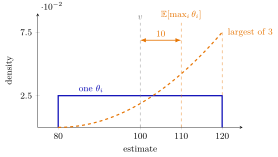
In the figure (the jar-of-coins example below), each estimate is uniform on and centred on the true value . The largest of three estimates has density for , which piles up near , and its mean is . If every bidder bids her estimate, the bidder with the largest estimate wins, so on average the winner pays more than the object is worth.
Add bidders: the largest estimate moves further above the true value, so a naive winner's expected loss grows. With there is no curse.
The curse is a mistake of naive bidders, not a feature of equilibrium. A rational bidder computes the conditional expectation of given her own signal and the event that she wins, and shades her bid accordingly. In a Bayesian Nash equilibrium of a common-value auction, winners do not lose money on average. The downward adjustment for this effect is larger with more bidders, because winning against many rivals is worse news; stronger competition pushes bids in the other direction, so the net effect of on bids depends on the model.
The curse does not arise with private values: a rival's signal then says nothing about one's own value. The same logic of "the event that the trade happens is informative" appears in adverse selection, for example in the market for lemons.
Key Results
- If estimates are with i.i.d. errors of mean , then for (non-degenerate errors), and the bias grows with .
- Rational bidding conditions on winning: bid less than in a first-price auction; in a second-price auction, bid in the symmetric equilibrium.
- In equilibrium the winner's expected profit is nonnegative; only bidders who ignore the information in winning suffer the curse.
Examples
Jar of coins. The true value is . Each of bidders observes with i.i.d. , so each estimate is unbiased. The largest error is the maximum order statistic of three uniforms: . If everybody bids her estimate in a first-price auction, the winner pays on average for an object worth : an expected loss of .
Two-bidder common value. Let with i.i.d. , and bidder 1 observes . Her unconditional estimate is . Suppose both bidders naively bid their unconditional estimate in a first-price auction. Bidder 1 then wins exactly when , and . She pays , so she loses on average whenever she wins. The equilibrium bid in this model is , here , which leaves an expected margin of when winning.
Prerequisites
Related Concepts
Sources
- Game Theory · Week 6
Aliases: Winner’s Curse, winners' curse Keywords: overbidding in common-value auctions, conditioning on winning, E[v | signal, win], jar of coins, oil-field auction Symbols: epsilon, theta
Last updated: 27 October 2026 11:52
Winner's CurseCommon-Value AuctionConditional Expectation Given an EventOrder StatisticAdverse SelectionMarket for LemonsFirst-Price AuctionBayes Rule