Chicken Game
Definition
The chicken game is a symmetric two-player normal-form game in which each player chooses (swerve, yield) or (go straight, stand firm), and each player's payoffs satisfy
Standing firm is best if the other yields, yielding is best if the other stands firm, and mutual standing firm is the worst outcome. A standard numerical version:
Interpretation
Chicken is an anti-coordination game: each player wants to do the opposite of the other. It models standoffs such as two drivers heading for each other, price wars, or a confrontation in which backing down is costly but collision is disastrous. In biology the same structure is called the hawk–dove game.
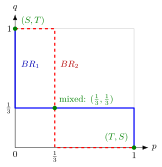
In the figure and are the probabilities with which players 1 and 2 choose in the table above. Player 1's best response is () when , () when , and any when ; player 2's is the mirror image. Because each player wants the opposite of the other, both curves step downwards and cross three times: at the two pure equilibria and at the mixed equilibrium .
Raise the crash cost and watch the mixed equilibrium fall towards ; with , standing firm becomes dominant and only remains.
Compare it with the Prisoner's Dilemma. There, defecting is best whatever the other does, so there is a single equilibrium. In chicken, no action is dominant, is worse than being the one who yields, and the game has three equilibria. The theory alone does not say which one is played; the two pure equilibria require the players to know who yields.
Chicken is a standard example for purification: if each player's toughness, that is the payoff from standing firm, is slightly private, the mixed equilibrium can be reinterpreted as pure behaviour by different types, and the game becomes a Bayesian game.
Key Results
- The pure Nash equilibria are and ; and are not equilibria.
- There is exactly one further Nash equilibrium in mixed strategies, symmetric, in which each player chooses with the probability that makes the other indifferent.
- No action is strictly dominated, so iterated elimination of strictly dominated strategies removes nothing.
- The mixed equilibrium is Pareto-dominated by , which is not an equilibrium: it is not Pareto efficient.
Examples
Mixed equilibrium in the table above. Let the opponent play with probability . By the indifference principle, yields and yields ; equating gives . By symmetry each player plays with probability , and each earns .
- The crash occurs with probability .
- Both players get at , which confirms the Pareto comparison.
- In the pure equilibria the payoffs are and .
General parameters. With , , and with , indifference gives , so . A more costly crash (larger ) lowers the probability of standing firm. The table above has , , , so .
Prerequisites
- Normal-Form Game
- Nash Equilibrium
- Nash Equilibrium in Mixed Strategies
- Indifference Principle for Mixed Strategies
Related Concepts
Sources
- Game Theory · Week 5
Aliases: game of chicken, chicken, hawk–dove game, hawk-dove game, snowdrift game Keywords: anti-coordination game, swerve or go straight, two pure equilibria and one mixed equilibrium
Last updated: 22 October 2026 19:04
Chicken GameNormal-Form GameNash EquilibriumNash Equilibrium in Mixed StrategiesIndifference Principle for Mixed StrategiesHarsanyi Purification TheoremBayesian GamePareto EfficiencyFolk TheoremPrisoner's Dilemma