First-Price Auction
Definition
In a first-price sealed-bid auction, each of bidders submits a bid simultaneously and without seeing the others' bids. The highest bid wins (ties are broken at random) and the winner pays her own bid; losers pay nothing. In a private-value auction with valuation , bidder 's payoff is if she wins and otherwise. A strategy is a bidding function .
Symmetric equilibrium (uniform case). If are i.i.d. with the uniform distribution on , the symmetric Bayesian Nash equilibrium with an increasing bidding function is
Interpretation
Raising the bid has two opposing effects: it raises the probability of winning and lowers the surplus obtained when winning. Bidding one's value guarantees a payoff of , so in equilibrium every bidder shades her bid below her value. The amount of shading, in the uniform case, falls as competition increases.
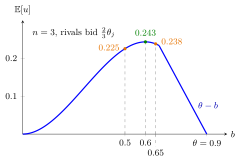
The figure uses the numbers of the Examples: a bidder with whose two rivals bid earns the expected payoff for , and for higher bids, which win for sure. Low bids rarely win and high bids leave little surplus, so the curve peaks at the equilibrium bid with payoff . The deviations to and (orange) give and , and bidding the value gives .
Move the bid : the expected payoff peaks at , here with payoff . Add bidders and the optimal shading shrinks.
Unlike the second-price auction, the first-price auction has no dominant strategy: the best bid depends on what the rivals bid, so a bidder needs beliefs about the rivals' values and strategies. This is why the equilibrium is computed as a BNE rather than by a dominance argument.
A useful reading of the equilibrium bid: a bidder bids the expected highest rival value, conditional on that value being below her own. In the uniform case the highest of rival values, given that all are below , has expectation , which is exactly .
Key Results
- General formula for independent private values (IPV). For i.i.d. values with a continuous cumulative distribution function (CDF) on , the symmetric increasing BNE is for ; for values this gives .
- Win probability. Under a symmetric increasing strategy, a bidder of type wins if and only if she has the highest value, with probability ( for ).
- Expected revenue with values: the winner is the highest order statistic with , so revenue is , the same as in the second-price auction.
- Interim expected surplus of type (uniform case): .
- Any bid above one's value is weakly dominated by bidding the value, but bidding the value itself is not a best response to the equilibrium bids of the others when .
- The Dutch auction is strategically equivalent to the first-price auction.
Examples
Deriving for values. Suppose the rivals use with . A bidder with value who bids beats a rival when , which has probability , so her expected payoff is
The first-order condition gives , independent of . Consistency requires .
Numbers with . A bidder with bids , wins with probability and expects . Deviating to wins only if both rivals have : payoff . Deviating to wins if : payoff . Both deviations do worse. Expected revenue is .
Two bidders. With the bid is and expected revenue is .
Prerequisites
Related Concepts
Sources
- Game Theory · Week 6
Aliases: first-price sealed-bid auction, First-Price Auction Bidding, FPA, FPSB auction Keywords: bid shading, b(v)=(n-1)v/n, symmetric bidding function, expected revenue (n-1)/(n+1), pay-your-bid auction Symbols: beta, integral, theta
Last updated: 17 October 2026 21:53
First-Price AuctionDutch AuctionRevenue Equivalence TheoremPrivate-Value AuctionBayesian Nash EquilibriumUniform DistributionOrder StatisticSecond-Price AuctionDensity of an Order Statistic