Static Game of Complete Information
Definition
A static game of complete information is a game in which
- each player chooses an action from a set simultaneously and independently: no player observes any other player's choice before making his or her own;
- given the chosen profile , each player receives the payoff ;
- the set of players, the action sets and the payoff functions are common knowledge.
Because nothing is observed before choosing, a strategy in such a game is simply an action, and the game is fully described by a normal-form game.
Interpretation
This is the simplest class in game theory: one round of choices, then payoffs.
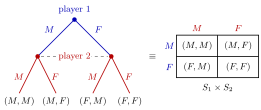
The figure draws the Prisoner's Dilemma as if player 1 moved first. Because player 2 does not observe that move, her two nodes lie in one information set and she chooses or without knowing which node she is at, so her strategy is a single action. The tree then has the same four profiles, with the same payoffs, as the matrix on the right: a sequential game in which later movers do not observe earlier moves is strategically equivalent to a static game.
"Simultaneous" refers to information, not to clock time. Choices made at different times are still simultaneous in this sense if nobody sees the earlier choices, as with sealed envelopes.
"Complete information" means that the structure of the game, including every player's payoffs, is common knowledge. It does not mean that players know what the others will choose; that strategic uncertainty is what solution concepts address. Nor is it the same as perfect information, which is a property of dynamic games in which every player observes all earlier moves.
The assumption fails when some player has private information about payoffs (a Bayesian game) or when some moves are observed before others are made (an extensive-form game).
Key Results
- Every static game of complete information can be written as a normal-form game ; with two players and finite action sets, as a payoff matrix.
- In a static game the set of pure strategies of player equals the action set .
- Solution concepts for this class include strict dominance, iterated elimination of strictly dominated strategies and Nash equilibrium (pure strategies in Week 1, mixed strategies in Week 2).
- If a player has private information about payoffs, the game becomes a Bayesian game (Week 5). If moves are observed sequentially, it is an extensive-form game (Week 3).
- A sequential game in which later movers do not observe earlier moves is strategically equivalent to a static game.
Examples
Prisoner's Dilemma. Two suspects are questioned in separate rooms and each chooses Mum or Fink without observing the other. The sentences for each pair of choices are known to both: static, complete information.
Cournot duopoly. In a Cournot duopoly two firms choose quantities without seeing each other's choice; demand and both cost functions are common knowledge.
Not in this class.
- Stackelberg competition: the follower observes the leader's quantity before choosing, so the game is dynamic.
- A sealed-bid private-value auction, in which each bidder privately knows her own valuation: static, but with incomplete information.
Prerequisites
Related Concepts
Sources
- Game Theory · Week 1
Aliases: simultaneous-move game of complete information, static complete-information game Keywords: simultaneous move game, one-shot game, complete information, strategic uncertainty, perfect information, Prisoner's Dilemma Symbols: element of
Last updated: 17 October 2026 21:53
Static Game of Complete InformationNormal-Form GamePure StrategyGame TheoryCommon KnowledgeNash EquilibriumExtensive-Form GameBayesian GamePrisoner's Dilemma