Multistage Game
Definition
A multistage game (with observed actions) is an extensive-form game played in stages , where the number of stages may be finite or infinite (then ). In each stage the players move simultaneously in a stage game , choosing actions , and before stage every player observes the realized action profile . Player 's total payoff is the discounted sum of stage payoffs
with required when . Because play is observed, everything that has happened before stage is summarized by the history , and a pure strategy for player assigns an action in stage to every possible . A repeated game is the special case for all .
Interpretation
The defining assumption is observed actions: at the start of each stage all players know the full history. In the game tree, the node at which stage begins after a given forms a singleton information set, so every history starts a subgame. This is what makes subgame-perfect Nash equilibrium tractable here: one checks that the continuation play after every history is an equilibrium.
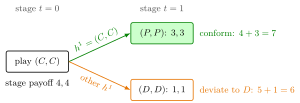
The figure draws the strategy from the example. The first stage () prescribes , which is not a stage equilibrium; the players then observe , and the second-stage action depends on that history: the good equilibrium after , the bad equilibrium after anything else. Both second-stage boxes are stage equilibria, so every second-stage subgame is fine. For player 1, conforming totals , while the best deviation in the first stage totals , so the threat of moving to the bad box sustains .
Conditioning on history is what creates new equilibria. A player can be rewarded with a good stage-game equilibrium tomorrow for playing a non-equilibrium action today, and punished with a bad one if she does not. With finitely many stages this works only if some later stage game has more than one equilibrium; when every stage game has a unique equilibrium there is nothing to condition on. With infinitely many stages, as in an infinitely repeated game, the threat of future punishment can work even with a unique stage equilibrium.
Do not read "multistage" as "players move one after another": within a stage the moves are simultaneous, and the dynamic structure comes from the sequence of stages.
Key Results
- Each history with begins a subgame; for the empty history gives the whole game, which is a subgame but not a proper subgame, and every gives a proper subgame.
- Playing a stage-game Nash equilibrium of in each stage, independently of history, is a subgame-perfect equilibrium.
- If is finite and every has a unique Nash equilibrium, the game has a unique subgame-perfect equilibrium, obtained by backward induction: play that equilibrium in every stage after every history.
- If some later stage game has two equilibria with different payoffs, a non-equilibrium profile can be sustained in earlier stages, provided each player's payoff difference between the two equilibria outweighs her one-stage gain from deviating.
- Subgame perfection can be checked one stage at a time by the one-stage deviation principle.
Examples
Reward and punishment with two stage equilibria. The stage game below is played twice with ; rows are player 1's actions and the first entry is player 1's payoff.
Its pure Nash equilibria are and ; is not one, since earns against . Strategy for each player: play at ; at play if and otherwise. Every second-stage subgame prescribes a stage equilibrium. At , conforming gives ; the best deviation, , gives . Hence is played in the first stage of a subgame-perfect equilibrium.
Prerequisites
Related Concepts
Sources
- Game Theory · Week 4
Aliases: multistage game with observed actions, multi-stage game Keywords: sequence of stage games, observed actions, perfect monitoring, two-stage game, conditional strategies Symbols: delta, element of, infinity, sum
Last updated: 14 October 2026 08:21
Multistage GameHistory in a Multistage GameOne-Stage Deviation PrincipleRepeated GameStage GameExtensive-Form GameSubgame-Perfect Nash EquilibriumBackward Induction